Featured

Mental Atrophy

In Biology classes, students learn a phenomenon called atrophy, which is physical organs losing their functional value due to the decay of their cells arising from constant non-use over a prolonged period of time. A few years back, I read about an incident of a Romanian girl who was chained down for a large number of years, and that made her bodily movements almost naught. By the time the rescuers reached out to her, she was physically worn out with her legs and hands almost losing their functional value. The doctors, subsequently, had to do a lot of therapy sessions to get her back on her feet. If you are confined to a dark room for an unusually long period of time, with no access to light, it is highly likely that you will lose your eyesight as your eyes go atrophy. In the deep waters of oceans, fishes do not have eyes because sunlight does not reach there, leading to a situation where eyes have no function to do, so over a period of time, the fishes’ eyes went atrophy.

Similar to physical atrophy, there is something called mental atrophy which is equally dangerous. Mental atrophy is tapering of one or more faculties of mind to non-functional mode when they are not put into use for a significant period of time. Unlike physical atrophy which is evidential, mental atrophy happens beyond man’s visible spectrum, and that makes it even more potent for self-debilitation without his conscious knowledge. In other words, mental atrophy pushes all that part of your intellect, which you do not use, into the no-man’s land in your brain and makes you gradually oblivious of them — the scientific community is almost in unanimity that cerebral cortex is the seat of mind, so the no-man’s land that I have mentioned is somewhere in cerebral cortex.

In simple definition, mental atrophy is memory loss arising from mental absenteeism. Hence, mental atrophy can be better understood using memory as a yardstick. Have you experienced like you knew and remembered something till a few moments back but cannot remember now? I am sure you did, so did I. This has nothing to do with mental atrophy as it is a temporary but recallable loss of memory. However, we also experience inability to remember things which we used to do or were in the realm of our immediate mental space till recently but had not been used for a while. And we fail to remember them even after constant efforts to recall, or sometimes we, finally, might succeed in our effort to recall. This is the first sign that some of our mental faculties are preparing to go atrophy because they have been pushed into the direction of the no-man’s land in cerebral cortex. Continued penchant to not put any effort to revisit the mental faculties will lead to them miniaturizing themselves into non-functional mode.
We are used to people saying that they lost track of the things that they were once good at doing. As a matter of fact, they are referring to the attrition happened to their skillset with which they excelled in their respective fields. The faculties that are prone to such attrition are abilities, capabilities and skills. Intelligence and wisdom, however, cannot be decayed by atrophy, rather, like the therapy sessions the doctors undertook to get the Romanian girl back on her feet, intelligent thinking and wise decisions are the therapy routes to reverse atrophy of the decayed faculties. Imagine that you were once an excellent chef who could dish out, without the aid of any culinary manual, cuisines savored by one and all. The recipes were in your active memory in ready-to-use mode. But a prolonged break from that profession did deplete your culinary expertise, for the skills of recipes that were active in your immediate memory had been pushed into the non-man’s land, i.e., went atrophy — an illustrative example of what happens to your skills when they are not used for a long period of time.  

I came across many people who excelled during their studentship but, subsequently, had failed or did not live up to the mark in their post-university life. Though factors like hard work, discipline, etcetera, matter, their decline in performance has something to do with mental atrophy, too. The vigor with which they used their mental faculties took a downward turn as they went through the rigors of life. They had stopped using some of their skills that made them the best students of their class or college. Over a period of time, they even forget that they used to use some of  their faculties in sterling ways, and thanks to the idling and the consequent atrophy of such built-in faculties, they will not be able to churn out results as they used to do at the colleges.

What makes us to undergo mental atrophy? Confiding to comfort ones and the resultant routinization of the way of living are major contributors to mental atrophy. Comfort zone is the personal enclave in which man feels satisfied with the way he is going about his life. Comfort zone creates a false identity of all-good, hence, a trap of being a perfect ground for mental atrophy. The zone allows us to put into use only those part of our intellect that is needed to generate the comforts as defined by the zone, and we get sweet-slumbered within the zone. A school of thought in Anthropology argues that every man carries inside him the repertoire of knowledge and information from the time the modern man had started to roam around the earth, i.e., 93000 years. If we go by this argument, human intellect is unfathomable. In addition to decaying the faculties that we stopped using, comfort zone draws a line on the usage of this unfathomable intellect, consequently, makes the faculties beyond this line to go atrophy. Over a period of time, if you feel discomfort inside the comfort zone of your life, that is an indication that unused part of your intellect — both that which you stopped using and the never used — is making noises as they are struggling to retain their relevance in the face of the continued fall into the abyssal plains of atrophy. If you listen to such discomforts, you can reverse mental atrophy, like the doctors did therapy sessions to the Romanian girl.

Listening to the discomforts of your comfort zone means that you have started to think intelligently about the limitedness of the comfort zone that you cozied yourself in. In other words, you become aware of the damage being happened to your intellect as you continue to stay in the comfort zone. Intelligent thinking opens up new avenues to break out and explore and, wisdom chooses the best avenue for you. In order this to happen, do not miss out the last noises of hope made by your fading-out intellect.

Right, Wrong; Good, Bad; and Correct, Incorrect

One of the discomforts that I am forced to go through is seeing people taking umbrage at the bold statement that one man’s right is another man’s wrong and that wrong and right are subjective. Is this true? Good and bad also get buffeted by similar linking and callous hits through the open justification that good or bad is largely person-centric, hence, is subjective tied to a person’s perspective. Though this thinking, for argument sake, may seem to hold some water, it is still a misfit with what good or bad stands for. Furthermore, man often gets confused with correctness for right and good, and, in the same way, incorrectness for wrong and bad though being correct and incorrect are the ways to be right and wrong, respectively.

The standards and norms of rightness are not set by the hands of man but nature, with man only having the choice of being either in harmony or disharmony with them — each having its own consequences. Any argument alluding or explicit that man sets the foundational rules governing right or wrong is an antithesis, for the principles underpinning the rights are universal in nature. They, like water boiling at 100 degree centigrade at normal atmospheric conditions, whether it is in India or the U.S.A., are non-negotiable, to say the least. Nature sets the rights flawlessly to differentiate them from the wrongs and goes to any lengths to uphold them. To substantiate this point, nature has kept innumerable illustrations for anyone who cares to notice them.

What is right or wrong? In other words, what can be called right or wrong? Anything that is in harmony with natural laws is right and that in disharmony wrong. Nature does not err, nor does it portray wrong as right and vice versa. Like man cannot physiologically — hence, mentally — mimic happiness, nature does not pretend because both its organic and inorganic existences are governed by the stable laws. Nature is nakedly honest in applying these laws impartially, irrespective of who faces the consequences of those laws. In other words, nature is always true to its indisputable laws. Gravity causes a falling object to fall at a faster and faster velocity that accelerates at the rate of 9.8 m/s2.  So the impact and damage of a fall from, say, the 9th storey of a building will be much higher than that of a fall from the 2nd storey. Nature is honest in applying this law across any man or object falling, and it says so openly to anyone who bothers to study its laws. Louis-Sébastien Lenormand invented the parachute after understanding this gravitational rightness and designed the skydiving gadget, accordingly. And any wrong — disregarding this gravitational rightness – in the designing and operation of a parachute can result in the wrong of a fatal fall. Impartiality and indisputability are the characteristics of natural laws, making them universal principles. So nature says that anything that is in line with its universally applicable principles is right. Conversely, anything that is diametrically opposite to this principle-centric approach is wrong. Honesty is the principle of telling truth, and truth is something that is indisputable. Consequently, there is nothing called half-truths because they can be disputed. Ultimately, it is either true or false with no grey area in between. So there shall not be any confusion to say that honesty is principle-based, not person-centric, hence, a virtue of rightness and that dishonesty is wrongness — somebody’s right is everybody’s right, and someone’s wrong everyone’s.

How does right or wrong get portrayed as subjective instead of objective? Our mental space is shared between cognitive elements, which constitute consciousness, and non-cognitive elements like desires, pleasure and pain.  In order to entertain our non-cognitive elements, we get inclined to subdue our cognitive skills, opening the green channel to justify our actions as right even when they are wrong. In this process, cognitive elements like logical reasoning attributed to our thoughts might get muted. Hence, objectivity is knowingly or unknowingly made to disappear, resulting in subjectivity taking hold.

Is good analogous to right and bad to wrong? Goodness is the after effect of being right. In other words, goodness is the feeling generated by doing the right things. For example, the feeling one gets by being honest is indisputably a feeling of goodness. It is not natural for a wrong to create a feeling of good though it may be possible that the contrary can happen sometimes. There are people who feel good when they do wrong things — something that is not in harmony with natural laws. A dishonest man may feel good in having booties from the dishonest deeds. These examples of (dis)honesty may make one think that good or bad is person-centric. However, goodness can not, as nature shows us — be associated with things that are wrong. So, how do we reconcile? While an honest man never defines himself as bad for being honest, a dishonest man may or may not define himself as good for being honest. This ‘may not’ affirms the fact that a wrong act can not inherently produce good feelings. The fact that acts of dishonesty can not invariably produce goodness emphasizes that wrong ultimately produces badness. That being so, the consequence of being on the side of rightness is goodness while it is badness with respect to wrongness.

When we talk about correctness, it always points to a way for being good or doing what is right. In other words, correctness is the unwritten procedural way — however, short or long that may be — to be right, so is incorrectness to wrong. The correct ways to be honest include both avowing to be on the side of right as well as pledging to be away from wrong. Vows on both these fronts are necessary because we have both conscious and unconscious motives. Our conscious motives can be tamed by the principles of rightness. However, our unconscious motives can surface suddenly, overwhelming  — and sometimes even being successful in overrunning — the principles of rightness. So it is imperative that in order to be in the path of rightness, we also take vows to disallow the unconscious motives to have any say. The correctness of being honest involves not only sticking to the principles of truth but also guarding oneself against the pleasures that dishonesty promises to provide.

You can choose to be on the side of either right or wrong, but to feel good within you, you have no right to be wrong but right.

Knowing the Truth

The most difficult task in life is knowing the truth. Many may dispute this statement by saying that there are even more difficult things in life. An aircraft pilot or astronaut, for example, could say that the piloting job involves understanding the intricate dynamics of physical laws, hence, is the most difficult one. A heart or neuro surgeon, similarly, can say that the job at hand will top in the list of difficult things, for it involves patient and subtle-yet-complex handling of vital human organs, the success or failure of which can be life or death for patients.

If we take a few examples from the other side of the spectrum, that is, trivial affairs, we will see that difficulty is inalienable in the planning and execution of even such seemingly trivial matters, too. For a vegetable vendor, the quantity of vegetables to be sourced for the daily business could be the most difficult decision because balancing perishability factor against turnover volume will be a tightrope walk for him as he needs to serve his loyal clients without stockout situation, simultaneously, should not end up with stocks of unsold items at the end of the day. Despite each of these jobs being justifiably claimed as the most difficult thing, I have no hesitation to reiterate that knowing truth, still, is the most difficult task in life, and at the same time, these claims for the most difficultness, too, are right because exploring difficulties are attempts to unravel the hidden facts.

“In the court of justice, both parties know the truth. It’s the judge who is on trial.” These are the most matter-of-fact words I had heard about truth in the recent past, and they were from Justice J. R. Midha of the Delhi High Court during his farewell speech. As the honorable Justice says, man — being a social animal — is knowingly or unknowingly put on trial by others, either forcing him to take the tormenting path of knowing truth or smooth sail into the uneventful and ignorant way of letting truth pass. The stressful path involves gauging intentions which is a difficult act of understanding as intentions can be bamboozled in deceptive words or actions. Words and actions can be hoodwinking but not intentions, for intentions are patently real irrespective of whether they are held by a man who is honest or not. Understanding real intentions enveloped in words and actions, hence, is the way to know the truth.

Understanding intentions is easier said than done. Nonetheless, dichotomy between words and intentions or between actions and intentions is not incognizable for a discerning mind. To discern, man should learn to distance himself from ambiguity by seeking facts involved. In other words, understanding is the search for facts, and that search needs to be sealed from the biased elements of emotions and belief systems which are both inherent and accruable in a man. Many a time, facts can be irretrievably mired in the ambiguities of beliefs like ideology, servility as well as emotions like liking, love, adulation, hero worship, etc. The rampaging marketing phenomenon of ‘social media influencers’ is an apt example of how an emotion like adulation is exploited by vested interests to create a smokescreen in order to effectively convey a message of goodness even when it may not be. There is no reason for social media influencers to promote a brand unless they are paid for it by the brand or that they gain media mileage from the equity of the brand. Without understanding this not-so-subtle fact, thanks to the smokescreen of adulation, “the influenced” chooses to believe the influencer when she/he says that a particular brand is the best value for the money. Parents getting influenced by the adverts starring film actors and buying educational apps, nutritional products, etc. can be an example of the emotion of hero worship unknowingly smashing the window of truth. Similarly, belief systems like ideology, servility, etc. pull in the opaque curtain between man and truth.

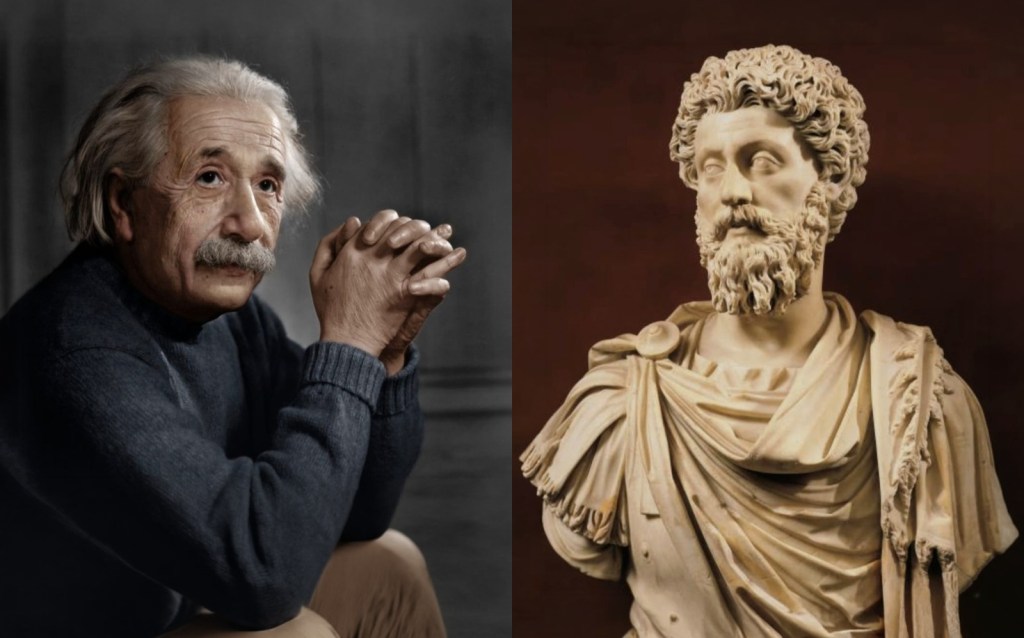
Discerning, the search for facts, is founded on reasoning which demands objectivity. It is impossible to be objective when reasoning is allowed to be stringed by imagination. Marcus Aurelius(AD121-180), the philosopher king, said, “Wipe out imagination.” The quote is about the need to avoid adding imagination to one’s reasoning faculty which evaluates and concludes the state of a man on its merit. Imagination is difficult to be figured out as it is more than assumptions and also has the careful feat of allowing presumptions to correctly aid a man in decision making. Assumptions are prejudices with no history of known existence. For example, we generally assume it will be true when people like acquaintances and kith and kin tell that they are in financial stress, hence, do need some level of help from us. Presumptions are estimates in the light of tested assumptions.

Every man is socially bound to deal with assumptions and presumptions whose veracity is a herculean task to fathom as he goes on dealing with strangers, acquaintances and kith and kin, and many of whom lie, habitually or otherwise. Instances like a friend telling a man, who is waiting for the rendezvous with him, that he will arrive in two minutes even when the friend — a habitual liar — knows that it will take another 15 minutes to reach, it is highly likely that the man will believe his friend because he assumes that his friend is honest. However, a discerning man will seek more information like the current location, the strength of traffic flow, etc. to make presumptions to aid him to know if the friend is telling the truth or not. Either way, it will become an incident for him to make a database for making future evaluation of the friend — to accept or discount or inflate his words to arrive at the truth? There are people who distort facts and figures in order to claim undue advantage or as a habit to cast aspersions on others. How do we deal with them? Again, a discerning mind will ask the right questions to arrive at the facts, and even if it fails at the first instance, such a mind will build up a database of such people, which tells it how much to discount or inflate the words of those people to arrive at the facts. However, man should make deliberate effort to not make the mistake of using such databases as the only source of finding truth, for everything, including people, is prone to change.

The world had not progressed from the time immemorial to this ultra modern-times of  Artificial Intelligence and space tourism without making assumptions. Though presumptions are more fact-leaning, assumptions have their place in arriving at truth. From our school days, we are used to this: let’s assume that…. So most of the things start with an assumption that something is true; then, we go on to test those assumptions for their veracity. Here, the operative word is ‘test.’ Every man should test his assumptions to know if something is true or someone is telling truth. How can a man do it? I remember ex-U.S.A. President George W. Bush once telling this: “Trust should be verifiable.” Trust is an assumption that someone is reliable, and that assumption should be verified for its correctness by evaluating the actions of that someone. In this process, assumptions should not be allowed to be influenced by emotions and beliefs as they create the smokescreen which disables the propensity to question. An inquisitive mind without being influenced by emotions and beliefs is the minimum prerequisite to test assumptions. The tested assumptions not only helps to actualize man’s urge to know truth but also add to his ability to see through things in future as every tested assumption is a wherewithal for future presumptions.

The burden of a guarded mind resulting from lies is probably the worst thing a man can carry because lies tie a man to the past, possibly punctuating and bogging him down. Being honest, however, does not have any negative implications for the past but opens the door for present and future rewards. It is not necessary that man must answer every question that comes to him, nor is that he has to tell everything about him to anyone in life; man can say: ‘no comments; but when he speaks, he must speak truthfully; and it is extremely difficult for a man who speaks truthfully to do something dishonest.

Man is not Even Small Enough

We often come across people who gloat over the mountain of knowledge they are carrying. There are others who compare themselves as better folks than everyone around. Some others go to the extent of feeling that they are polymaths who could answer queries of anything and everything. The breeds that think that having higher physical strength or wielding powers make them big are not less in our society. These and similar megalomaniac expressions are borne out of the poor understanding of oneself vis-a-vis the limitless, fathomless knowledge and phenomena that the universe has kept out in the open and beyond. Such vainglory thoughts show the lack of discern to understand how insignificant man is in the universal canvas and how smaller and smaller he is becoming in this ever-expanding universe. The wise souls, who lived hundreds of years ago when the understanding of the universe was limited to some elements of earth and the solar system, knew the littleness of man’s knowledge. The 2400-year-old quote, “I know that I know nothing,” by Socrates captures the essence that the knowledge man claims to have acquired is not even a little but little in the backdrop of the endless horizons of knowledge kept open to explore by the universe.

Space and time in various logical permutations and combinations are used by the universe to reveal its thoughts, wishes and demands. So if we evaluate man using these two universal dimensions, we will get an idea where man stands in his claim of being big. The diameter of the earth is 12,756 km, and though this is a good spatial coverage, it is too small in our solar system, which has a diameter of 287.46 billion km. Such a vast solar system, however, is only a dot among the many other solar systems in our Milky Way galaxy. The Milky Way boasts a diameter of 105,700 light-years — a light-year is 9460800000000 km. So the diameter of Milky Way is 105700×9460800000000 km. Unsurprisingly — from the perspective of the universe– this gigantic Milky Way is another small dot in the numerous galaxies in our universe whose observable reach from the earth is 93 billion light-years. And the universe is still expanding at the speed of light, i.e., 300,000 km/second. Imagine what vast knowledge and phenomena the universe has kept in this immenseness of planets, solar systems, galaxies and beyond!

So, how big is man in this infinite universe? Man is not even a dot in the universe — too small to be considered as something.  What level of knowledge has man acquired as compared to the knowledge out there in the observable universe and beyond? Little. I do not know every place and aspect of my village: Chavara Thekkumbhagom, which is only 8 sq. km, where I was born. I think this is same for almost all the humans born on this planet. As man stands as an insignificant dot and that the knowledge he has is little, can anyone claim to be a polymath or to carry a mountain of knowledge?

Our universe is 13.80 billion years old; the sun is 5 billion years old while earth 4.60 billion years. The first living nucleus is estimated to have sprouted 3 80 billion years ago, and the first Homo sapien: Lucy, whose fossil remains were exhumed in 1974 in Ethiopia, is estimated to have lived 3.20 million years back. Modern Homo sapiens are believed to have started roaming on the earth 200,000 years back. Vastness of times had been elapsed before us, and even more times would unfailingly succeed us, with each segment holding unimaginable information and knowledge. A life of 70 or 80 years is only an incipient flash to understand anything significant from the knowledge layered in such an extensive time dimension of the universe.

There are billions of stars that are billions of light years away, which have started their journeys to earth before we were born but would not meet us because our time is too short on this planet. And most stars which light the night skies are already dead to become black holes, but we see them because the lights emitted by them before their death are still travelling to earth. Interestingly, we do not know which of these stars are dead or alive — so even making a wish on a star can be a wishful thinking. In such oblivious vastness of time, man’s short lifespan gives him not enough time to acquire anything that can be called big.

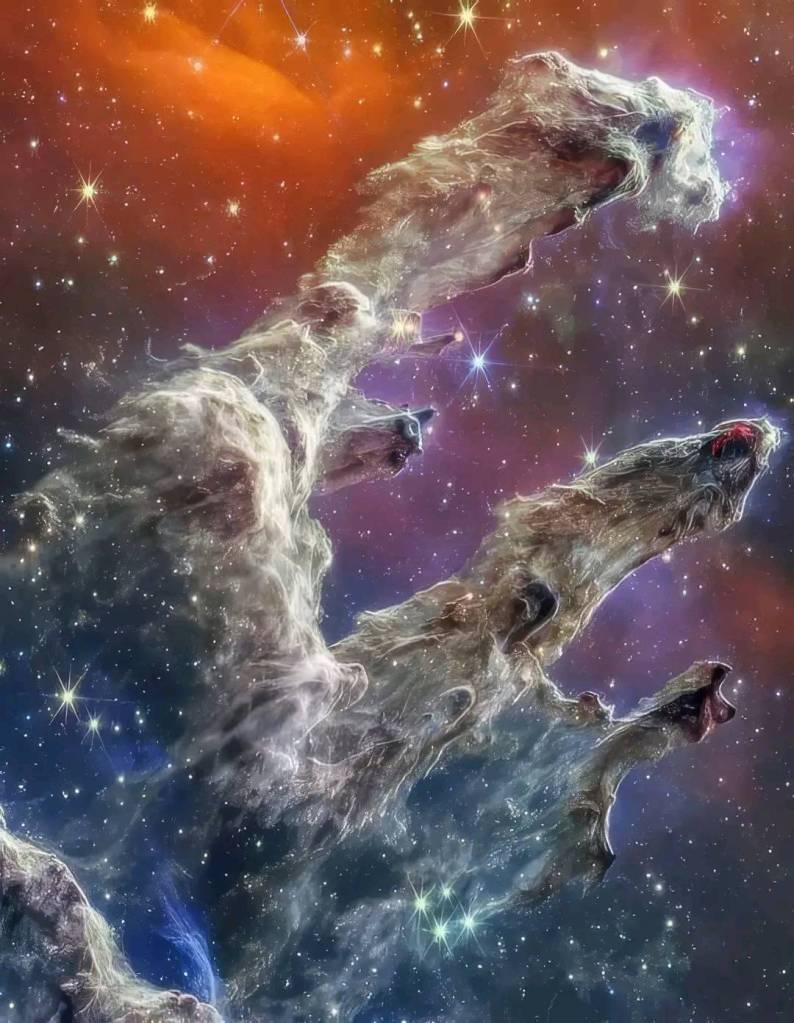
A picture of the “Pillars of Creation” sent by James Webb Space Telescope:

The universe is willing to reveal everything about it to a man who is willing to explore it. The first interstellar probe: James Webb Space Telescope sending valuable information on the ‘Pillars of Creation,’ star births, nebulas, black holes, interstellar dust gains and other galactic phenomena is the illustration of the universe’s willingness to let man know its secrets. At the same time, man does not have the faculties — at least, the universe thinks so — to acquire and hold all that the universe is willing to divulge. In the last 2500 years of known human history, only one man: Buddha is known to have attained enlightenment, or Nirvana. However, Buddha’s enlightenment was broadly spiritual revelation that also had  meaningful pointers for physical and mental wellbeing.  But Buddha never talked about the factors like the circumference of earth, the speed of light or how stars are formed because probably, such things were not revealed to him by the universe after realizing that even an enlightened brain was too small to hold the vastness of knowledge in its repertoire.

I remember Time magazine featuring the cricket maestro, Sachin Tendulkar, on its cover page a few years back. In the article, the author listed out some unique qualities of Sachin Tendulkar as a cricketer, and one of them had a connection to his physical atribute. That quality was good peripheral awareness, enabling him to have a quick assessment of the fielders positioned and adjust his game, accordingly. This spatial awareness was accentuated to the best level due to his feature of no-tall physique. It is a scientific fact that when you are shorter, you have a lower centre of gravity, giving more room for manoeuvrability. The point I am trying to put across is that man should look around for a better understanding of people and things and that he can do it effectively if he does it from a mental frame of humility. The universe has set spatial dimension in such a way that man needs to take one step back without mitigating his self-respect in order to better understand the universe and its creations, including his fellow beings.

It is unavoidable, though not inevitable, that people get carried away by their success, making them overly proud about their achievements. That catapults them to think that they are big and highly knowledgeable. For all of them, the universe has this simple message: it is plain at the peak!

Greed

I happened to read a news clip that a woman from Kerala wired around Rs.40 lakhs -roundabout US$48,000 — over a period of time to a virtual male facebook friend whom she had never met as the man convinced her online that he had sent a Rs. 2-crore — roundabout US$240,000 — worth of gifts, hence, needed money to pay customs duty at the Delhi airport to clear the gifts and send them to her. After realizing that she was conned, the woman filed a police complaint only to know that the man was sitting somewhere in Nigeria! News of people getting fooled are aplenty nowadays! Scams after scams of people getting defrauded through false but seducing promises by phony financial companies have become news with shorter shelf lives as the society seemed to have become callous to such news in abundance. I  wonder why people get fooled in such easy ways. Lack of reasoning, which happens mainly because of greed, is the main cause of getting fooled. Greed is anathema to reasoning and vice versa.

What is that which drives a man? It is ambition! It is the one factor that lifts man up from the falls, fuels him to recoup, renew, and resume the journey. It is like the currents in an otherwise stagnant water body, giving life to the waters to flow — with their presence or absence, currents make waters to flow or go stagnant respectively Ambition, similarly, creates the momentum to go uphill irrespective of the nature of terrains to tread. Even hope without ambition is hopeless! Without ambition, man is dead as the wood waiting to go smoke and ash. Whether it is in a material sphere or a spiritual universe, ambition energizes man to build the accrual for the next step to happen, sooner or later.

Ambition not supported by hard work and reason is greed. When ambition takes shortcuts to circumvent the hard paths to progress, it changes its chemistry to become greed. Ambition has parallels while greed is unparalleled, giving the greedy ample space to become susceptible to fraud as well as to defraud others. Ambition is person-centric, making it to survive irrespective of the fortunes or misfortunes of others. Greed can succeed only at the misfortunes of others, so its sustainability depends on external factors.

Greed is borne out of lack of reasoning and has an anteroom of negative traits that a man harbors with or without his conscious knowledge. Laziness, jealousy, lack of knowledge of how nature works and similar self-defeating traits create an unholy space within a man for the unreasonableness to take a firm hold on how he views life, sometimes without him being fully aware of it. These negative qualities are forgiving to oneself as they set no limit for themselves, thereby creating a sense of normalcy in being unreasonable.

Laziness has no known medical remedies as it is not a physical or mental illness. Many may dispute this by stating that laziness is a state of mind, so it can be set right by psychological treatment. Well, I will not be a student to such an argument. Laziness arises out of lack of goals in life. Goals add timelines to one’s life, then, everyday becomes an elapsing dot in that timeline of marching toward that goal. And this wakes up a man from the sweet slumber of laziness and go into action mode. Life without goals is like a ship without a functional engine meandering directionless to where and when the winds and currents ask it to go — the ship has set no shore to reach. Similarly, man without goals switches off the engine of reasoning, making himself a unstable ground ripe for longing for gain without pain.

Jealousy is the acceptable uncomfortable  about the well-being of others.  It stops a man from learning the reasons behind others’ success, still, coerces and cajoles him to yearn for the same level of  success. So jealousy aims for success without making any investment to learn from the lessons and master the reasons. In other words, jealousy stops man from being reasonable. Jealousy is a big hindrance to progress in life; it ties down man to the narrow confines of his mind where he, instead of competing with the attributes of success, gets obsessed with his limited knowledge about others’ success, thereby absenting himself from exploring the times that offer opportunities for progress. A neighbor’s progress ought to be an event for inspiration, so is a classmate’s scaling of career heights a proud recognition and a case study to point to our children. But such perspectives are possible only if man is bereft of jealousy.

Nature’s laws are non-negatable and unforgiving; they take their course irrespective of who and what are involved. For example, if a moving mass like a car with passengers collides with another significant moving or non-moving mass at a speed which is unsustainable for human life, then, irrespective of whether the passengers were going to a religious or non-religious place, they will die from the forces of collision. This is a demonstration of the physical laws being non-negotiable and unforgiving.

Nature offers nothing free, and everything has a cost to and for it. There is no reaping without sowing in the books of nature. There is no reaction without action, nor is there any return without investment. For every drop of water from the skies, the skies have to make an investment of energy in the form of heat and wind to evaporate ocean waters and bring up in the skies. Greed does not take this simple, straight fact into consideration — the greedy believes and anticipates that something is going to come to him or her out of nothing. Another notable aspect of nature is that it does not love anyone or anything unconditionally. The existence of innumerable food chains is the explicit notification from nature about this limiting nature of nature. The woman who wired money to the man thought that he had unconditional love for her that he would send free gifts worth millions. Greed takes for granted these laws of nature!

Greed is incompatible, incongruent and disharmonious in nature. Man, being a nature’s produce, is bound by this ruthless and unchangeable law. Trespassing this law will inevitably be met with pain and loss.

Problematic Perspective for Living Better

Many of you may find the blog title intriguing, and there is no wonder in such a thought as man is used to seeing problems as troubles in his way. However, I am trying to look at problems in a unique way which is hard to practice but possible to do as we all did it during our student days. In this process, I will try to point out the distinction between the ways in which we solved our student-life problems and the ways in which we solve the problems of the life past the student days. Which of these two ways is better in solving the problems of life? Aren’t the ways we solved the problems of student-life superior to the ways we solve or fail to solve the problems of life? Or, the ways that were finetuned by your experience, seasoned as sharper and quicker, are much stronger and better equipped to solve the problems of hard-life as compared to the ways of student-life? If the answer to this question is yes, why do many people fail to score good enough in solving the problems of life though their student-life scoresheets were filled with A and A+es? Conversely, why some with relatively poor student-scoresheets do well in solving the problems of life? Though there may be many reasons to the answers of these questions, the fundamental reason remains the same, and that is the moot point of this blog.

We kept learning through the student life, and the ultimate test of those learnings were the examinations where problems in the form of questions were asked. Some we answered, and some others we failed to answer. But one striking aspect across both types of questions was that we did not consider them as intimidating or superior to us. They were just testing our knowledge, not us, so our ego was not involved while answering or not answering them. Even when we failed to answer questions, we did not feel like less or humiliated because our ego was not tested. Failure to answer questions by teachers did not create any ego vis-a-vis the teachers, for, as students, knowingly or unknowingly, it was clear to us that they were testing only our knowledge. We saw only the questions that were asked, not the people who asked the questions, and used the knowledge to solve them. And, then, where were our ego? Nowhere as we had no ego while solving the problems. Isn’t, hence, this student-method of seeing problems, not problem-creators, and solving them, accordingly, a better method to solve the problems of life? It, indeed, is.

It is impossible for man to keep himself away from people as he is not natured to be unsocial. Hence, rendezvous or other ways of dealing with people are unavoidable, if not inevitable. The very fact that we are social beings shows that we are interdependent, meaning one man does not hold all the resources in him to being, and so as people do, this or that thing, as necessitated, does come across us. Hence, we have to deal with people and things irrespective of whether we like it or not. Every man who approaches us and every issue that comes in our way are to be seen as problems needing solutions, not as trouble-makers that come to test our ego. They are here to test our knowledge and skillsets. If this distinction is understood, we have passed the preliminary to handle them. And as long as we see both men and things as problems-needing-solutions, we are in for a safe passage through them. And, how does it happen?

We are used to these types of routine wailings: He is a problem in my life, this or that is a problem I have to handle. We need to ask this question: Is that person or what he does the problem? Are the issues/questions raised by him, like the questions asked by our teachers, are to be addressed and solved or should he be considered as the problem? If man keeps his ego out of the way or keeps it oblivious to himself while dealing with another person, it is certain that he will deal with the questions raised and the issues brought forward and tries to solve these problems using his knowledge, skills abilities, capabilities, intelligence and wisdom. Man may succeed or fail in this process, and, accordingly, consequence follows. The merit with this approach is that man deals with the problems of life meritoriously without getting ego injured. In order to differentiate problems from problem-creators, man should be guided by rationality. Marcus Aurelius, the great philosopher king of ancient time: AD121 to 180, says this: “Rationality is intended to signify discriminating attention to every several thing and freedom from ignorance.” Discriminating attention is reasoning. And reasoning trains mind to discern true from false.

I wish to recall a personal experience from my graduation days. My schooling was in vernacular medium that ensured that my both verbal and non-verbal English language skills remained subpar. So I was always on a retreat when English language skills were well played by my graduation acquaintances. And any small attempt to tread the English language path was well discouraged by the good Samarians by satirically ballooning the mistakes made. On the positive front, thankfully, they, in fact, made me to see my shortcomings, and I was convinced that I needed to improve substantially if I had to ever utter or write a sentence in English language without mistakes. I bought Wren and Martin High School Grammar and Composition book and studied it to my exclamation. Besides, I started to read the Hindu daily, Frontline and other English language publications to improve English, where I met what I was learning from Wren and Martin. And I still continue this never ending saga of learning English language. It is all those shortcomings of mine that I was made to see, not those who did that, that truly made the student in me to brush aside the ego and learn to grow.

If man remains steadfast in the track of reasoning — thereby training his mind to keep ego and emotions inoperative — he will see problems, not problem-creators as they will stand non-intruding but friendly as our teachers did. This differentiating or discriminating discerning, then, shall take out the intimidating or bigger-than-me image of problem creators as man will see only the problems. It brings the much-needed feeling of being superior to the problems that we face — the feeling that I am much bigger than the problems. so can I.

Marcus Aurelius said, “Is it not plain that the inferior exists for the sake of the superior? But the things that have life are superior to those that have not life, and of those that have life the superior are those that have reason.” Reason brings in life to a man over a problem that is lifeless, so a lively man effusing with reason is superior to any problems that come before him. This is how we faced the problems as students. We were leading our student-life with the reasonings provided by the books of science, the very reasons we were called students. And equally the very reasons why we did not see our ego, did not feel intimidated by our teachers and the very reasons that guided us to focus on the problems, leaving the problem-givers oblivious. This student-life approach of reason and reasoning to treat people and issues that come to us as problems-needing-solutions is probably the best possible way to live life.

Abundance

What is the least abundant part of our knowledge base? The unobvious answer is the knowledge of abundance. Man is mostly oblivious of the fact that nature has bestowed everyone with abundance — of invaluable, immense and unlimited resources that are capable of providing him with progress without having to vie with his fellow beings. And this ignorance is the main cause of ill feelings like jealousy, hatred, one-upmanship, etc. It also creates the feeling of less in him as he sees only less and misses the more lying within. ‘The sky is the limit’ happens only when man competes with himself as he is unrestrained to go after and even exceed the goals while when he competes with others, he restricts himself to reach only up to their levels, and even if he exceeds them, he loses the motivation, for they are not there anymore to compete with.

If we consider the self-governed, but not autopiloted, journey of competition-within as a river, then the knowledges that come from the environs are the tributaries that add value to the mountain springs, i.e., the river in you. A river cannot compete with its tributaries as they are there to feed, not to fend off, the river. So it is counterproductive to compete with the elements —  like your friends or foes — of the environs that you dwell. Friends and foes alike give lessons to learn from though the lessons may differ in nature. The knowledge from those lessons, however, are the tributaries to you, and the wise decision is to let them feed you. But, how can man get himself out of this debilitating, self-limiting matrix of competing with others? A paradigm shift in thinking and behavior that will surely makes him hit the jackpot lying within is inevitable. That shift is fueled by the redefining and reinventing realization resulting from an internal churning whose rules are unique but do look arbitrary to others.

The realization is that there is enough for everyone on the earth and that competition with imaginary or real contenders is not the way to harvest the unlimited wherewithal planned for you by nature. Rather, healthy competition  — both: for and against — with oneself to find the abundance-within is the thoroughfare to the abundance out there. How do I compete with myself? It is impossible for today to compete with tomorrow, but it is within the realm of possibility for today to compete with yesterday. Today needs to be an improvised version of yesterday, meaning man’s learnings from the deeds of his past and putting them into use can equip him to self-compete in order to create a better tomorrow. Today is the theatre of that creation, and the higher the level of activities in this theatre, the better the utilization of the resources to create a better tomorrow.

The abundance of resources in you has no limit unless you put a cap on it. And this unimaginably high resource trove can largely be captured in one term: intellect. Though emotions have immense value and importance to individual existence, I am deliberately keeping emotional elements out of the resources because emotions cannot prove or disapprove facts and that mining of the resources from within is a fact-based voyage. Intelligence and wisdom are the manifestations of human intellect. In other words, harvesting of man’s intellect is done by the tools of intelligence and wisdom.


It will be suboptimal to chain down the term: intelligence to any particular definition, but we can say that intelligent thinking shows the ways to choose from while wisdom chooses the best way. Wording in a different way, intelligence does mind-mining that lets out not-good, good, better and the best out of a man while wisdom functions as the judge to zero in on the best. Intelligence is aided by skills, abilities, capabilities and acquired as well as basic knowledges. The adage that none other you decide your destiny implies how intelligently and wisely you utilize the intellect latent in you.

The most beautiful part of intellectual abundance is that it is packed in layers. Touching upon one layer of this abundance and mining it using your intelligence and wisdom will automatically connect you to the next layer of abundance planted in you by nature. That is why success, which is the accomplishment of a pre-set goal, is never a full-stop but a pause to ponder over and connect to the next layer of progress. In order to maintain the continuum, an abundance-savvy nature ensures that it provides abundance to a man, both inside and outside him, when he gets ready to take it handful. This getting-ready is competition-within. A man who is ready from within will find abundance everywhere outside. There is no stopping of such a man because he is not competing to take away anyone’s resources but competing with himself — letting loose his unfathomable intellect to take away the dues allocated to him by nature. He realizes that resources out there are aplenty and that he has to only present himself to claim his share as anyone else can do.

A telltale example of abundance is the relation between the fishermen and the waters of the oceans and the seas. The vastness of these waterbodies is an epitome of resource-abundance that nature has openly concealed for man to meaningfully exploit. And none other than fishermen know the true meaning of this nature’s gift! Fishermen of a fishing vessel do not compete with their counterparts of another vessel for a better catch while casting nets, rather they compete with themselves by dwelling deep into the resources-within like their experiences and the knowledge to gauge the waters for a good catch. Competition for a better catch is anathema among fishermen because fishermen know that oceans and seas had never intended to have their resources exploited that way. Abundance does not call for external competition, and shoals and schools of fishes are the signboards by nature to reemphasize this point.

Time and nature are the best teachers; while time teaches lessons from our past, nature keep its doors open to anyone keen to observe and learn from how it operates. The message of abundance is the best lesson that nature is conveying , and missing it is likely, but hitting it is not a chance but a choice that man has to make deliberately.

Note: This article of mine was published in the souvenir that came out duting the eve of International Fisheries Congress and Expo 2024 organized by Kerala University of Fisheries and Ocean Studies (KUFOS) & College of Fisheries Panangad Alumni Association (COFPAA).

Message of Easter

Many of us will quickly answer: ‘Easter eggs’ if asked to tell something special about Easter. I am not sure how many will be able to answer the question: what is the message of Easter? Easter is 2021 years old, so is its message. No one will have any doubt that Easter is the celebration of the sacrificial death as well as the resurrection of Christ. Some may raise questions about His rise from the death, and it is okay to do so, even such a question will be all right with Jesus. Christ’s resurrection unequivocally establishes that he is the Son of God. Nonetheless, the message of Easter is embedded in the sacrificial death.

If you read the New Testament of the Holy Bible, then you will notice that the biggest miracle Christ did was that He never did any miracle for Himself! He did many miracles: healed the sick, raised the dead man Lazarus and brought him back to life, fed 5000 people with five loaves and two fish and so on. But Christ did not do any miracles for Himself, including saving Himself from the painful death! Why? Had He done any miracle to save Himself, the very purpose of His journey to earth would have been defeated, and we would not have been celebrating Easter as it then carried no message.

How did Christ die?  We know the answer is  crucifixion. Yes, but if we go a bit deep into His death on the cross, He died from the inability to breathe. When a man is hanged with his hands stretched out and fixed to and legs affixed on a cross for a long period of time, it will be difficult for him to breathe because the functions of lungs will be severely impaired.

As He gasped for breath and took the last breath before leaving the world, Jesus said, “Father, forgive them, for they do not know what they are doing.” The message of Easter is forgiveness, and it is the essence of Christianity. Christ told his followers to take the cross and follow Him. The cross of forgiveness, and this journey is not an easy one but very painful. If someone slaps you on the right cheek, turning to him the other also needs ability to accept the physical and mental pain with calmness and without any tinge of vendetta, even in the thoughts. And that ability comes from forgiveness.

Even if you are able to memorize the whole Bible and even when you are a frequenter of churches as well as an active member of church activities, if you are not carrying the cross of forgiveness, you are no way near to Jesus, who will tell you whenever you meet Him, “I don’t know you.” He will show you your name missing from His supercomputer. Throughout the verses, He emphasizes forgiveness. If I am allowed to paraphrase one such verse, it goes like this: When you come to the place of worship to offer prayers to me, if you still have enmity toward your neighbor, leave the offerings at the worship place, go to your neighbor, forgive and reconcile with him, then only will I accept your prayers. Christ taught only one prayer to the people around Him, and it was a prayer to the Holy Father. I am afraid to recite that prayer because it has a sentence “… forgive us our sins as we forgive those who sin against us…” So when I recite this prayer, I am telling God to forgive my sins the way I forgive those who did bad to me. Do I forgive people? If not, my sins will not be forgiven. What a sentence to ponder on!

I wish you all Happy Easter. May the virtue of forgiveness take root and flourish in you!

Republished the blog written in 2021.

Selection

People answer in different ways if we ask them, “What is the most likable thing about social media?” Knowledge acquisition, new information, friendship, pastime, etc. are some of the answers that will come onto the table. Though I, too, like these things of social media platforms, the most I liked is something else. WhatsApp, one of the most popular social media, gives many options like delete, share, archive, unarchive, see to who all messages got delivered and who all had seen the message, and so on. All these options have a prerequisite to be fulfilled before they can be executed, and that is one has to select the post on which any of these options needed to be acted. Yes, the feature of selection is the most important thing I like about social media. I can share, delete, archive in order to escape the frequency of incoming messages, even ignore messages by not opening it and so on by using the feature of selection.

Selection is an unavoidable element in life, which we do knowingly or unknowingly. There are many interesting factors about and around the phenomenon called selection. Selection is the manifestation of a thought process that decides how man responds in a given situation Hence, it is an expression of man’s power to choose — the culmination of a churning process that evaluates the utility value of different alternatives and choose one, accordingly. The churning process is necessitated by either situational compulsions or suo motu inclinations though both are not mutually exclusive. How does this churning process work? In other words, how do we select or make a choice?. A straight answer is through our thoughts – thinking that decides priorities.

Countless wise souls who lived before us gave an invaluable maxim: “Man is what he thinks.” Nothing but this universal truth is responsible for whatever ultimately happens in our life. Every event that happens in our life may not necessarily look like an output of our thought process, but if we dive deep down and look at the event, revelation will come that it was a direct or indirect consequence of our thinking. Now, the big question: what forms the basis of man’s thinking? A man can think about something with direct or indirect or no knowledge about it or with a combination of them. To a large extend, man thinks based on his ‘learning’ — either as an extension of that learning or as a total departure from that learning. Inventions, for example, are the fruits of the latter kind of thinking. A man behaves — selects to conduct himself in a particular fashion — based on his thinking which is largely dictated by his learning. So we are now at a coordinate that says selection, the power of choosing, is based on thinking which is mainly fueled by what all that man had learnt from his life.

I remember my management classes where I learnt the relation among perception presumption and assumption. Man tends to learn through his perceptions which can be influenced by his preconceived notions called assumptions as well as by presumptions. Assumptions influencing learning is dangerous because, unlike presumptions, assumptions are guesses based on past events or can have no connection to any past event, with no realistic underpinning to a particular situation on hand. Conversely, assumptions can be based on earlier perceptions, meaning each feeding the other. How to extricate one’s perceptions out of the assumptions in order to reach to the reality is at the center of learning. By and large, man can not escape the bane of assumptions without deliberate effort to obliterate them. Another scenario is that what if the perceptions, which can form the bases of assumptions, itself were wrong and away from reality?

On the other hand, presumptions have elements of realistic value drawn from the task on hand. Presumptions are conclusions based on evidences gifted to a mind capable of critical thinking. Every task or a situation on which man has to make a choice has unseen roots of knowledge branching out, and these roots reveal the fruits or their absence on the tree that is the task. The seeing and reading of these roots is presumption. And, how does man presume? There is no silver bullet to do it but a thought process that filters out assumptions and subjectivity by using intelligence.

Learning is complex as much as a concept as its practical leanings, for learning is multidimensional as well as progressive, meaning there is more than one way to understand anything about life and that learning is a gradual process, built brick-over-brick — with each brick further strengthening the learning  or altogether demolishing the very learning itself in order to give way to a new learning. There is not a single man who has driver’s license to drive the vehicle of life, rather he is perpetually on a ‘learner’s license,’ learning everyday a lesson or two to choose the best from among the alternatives.  

Common Sense


The human quality that is expected to be the most versatile is common sense, yet, many a time, it is the most missing element from people’s behavior. I was prompted to think and write about common sense by two recent instances. I received a group-photo of a birthday function, in which a man was pictured with the face down. Well, the man would not have intended to keep the face away, otherwise, had not have posed for the photo. Then, whose mistake was that the person did not get pictured properly? It was the mistake of the person who clicked the snap as he/she did not show common sense to ensure that all the faces were captured by the camera.

The second incident was connected with social media. In this era of exponential explosion of social media, it is not uncommon that many people share messages on social media without checking their veracity. I had seen instances where highly-educated people sharing information that did not stand basic scientific scrutiny. Also, it is often that people share spurious information which can easily be filtered out by using basic intelligence. So, what makes people to unknowingly fool themselves in this process? It is the lack of common sense.

What is common sense? One of the most difficult questions as it does not have a straight answer and that any answer will be inconclusively debatable. A quick conclusion one can draw from the above incidents is that common sense involves quick and timely application of mind. Why does the application of mind have to be quick and timely here? Because common sense is the apt response to a certain evolving situation where time to apply mind comes in and passes out quickly. For example, the photographer would feel bad at the photograph he had taken and most likely would do it properly if another chance had been given. But common sense does not repeat by itself with respect to a particular context. So that brings me to say common sense is the apt response resulting from the timely and quick application of mind.

The room that common sense offers to anyone to understand and interpret it is too big to accommodate just one definition. So there is ample space to look at it from many perspectives. The dual-word term contains an easy word: common as well as a difficult one: sense. The easy word: common stands for minimum-required or minimum-expected. So common sense is the minimum required or minimum-expected sense. What is sense or being sensible? It is a herculean task for anyone to explain what sense is as its realm spreads across many disciplines like a psychologist will explain it in a different way than how a biologist does. Sense is the ability to discern right and wrong. Now, I have walked into the usual minefield where people argue that right and wrong are relative — though not relatives — and that one’s right can be another one’s wrong and vice versa, Despite such high level of subjectivity, right can be clearly differentiated from wrong because right can never be wrong, nor can wrong ever supplant right — this is non-negotiable and fundamental.

There is a saying that truth is the only absolute thing in this world, meaning everything else is relative. Hence, whatever the way I try to explain right and wrong, it will have that element of the inevitable relativity. Harmony is the key word that I am using to differentiate right from wrong or vice versa. Right is an action that is capable of producing an outcome which is in harmony with the natural outcome of that action. Natural outcome is guided by a set of principles for doing things which if done by nature will be impeccable. In other words, common sense is the ability to act which will be in harmony with the way nature would have done had the action been outsourced to it. Nature does not spread falsity unlike we do in social media, nor does it throw open countless panoramic spots in awkward ways like the photographer did because nature can not be anything other than natural, i.e., can not be anything without common sense.

If we bring together the aforesaid two perspectives and hybridize them to arrive at a definition of common sense, then it can read like this: common sense is the apt response resulting from timely and quick application of mind in conformance with the natural principles that govern such a response. There can be many more plausible explanations for what common stands for like it is a manifestation of basic intelligence, a tool to measure speed of thinking, an asset that is inert in presence and powerful in action and so on. Whichever the way one understands and explains common sense, there are none who do not show a bit of it at some point of time in their life as it is the minimum sense everyone is blessed with.

Determination: the Invisible Element in Decision-Making

There are many factors that are characterized by different people as the most important things in life, and a few of them are love, living in harmony and happiness. Though there exists cross-linkages — like one leads to another, mutual inclusivity among these factors — each one of them exists on its own merit, meaning each one’s presence contributes qualitative value to life. Here, the operative word is presence because whether to have these qualities in life or not is a personal choice, so is a decision. Hence, whether man considers love or happiness or harmony as the most important thing in his life, there is a decision behind it. Without a decision to possess them, they will remain as virtues that have only conceptual value while a decision to own and make them a part of his personality will bring their habitual value to man. So, where do I stand now? I stand where I have to say that the most important thing in life is to decide to have the most important things in life.

The maxims like life is a bunch of decisions, your present is the decisions of your past, your future depends on your present decisions and decisions can make or break your life underscore the important roles decisions play in shaping up man’s future. It is preferred to say decisions rather than decision because a decision is closely followed by a consequential decision in its execution. For example, setting alarm to wake up at, say, 6 a.m. is one decision, but to get up when alarm rings is a consequent yet another decision. Similarly, stopping to while away time is one decision while choosing to invest that time in productive use is another decision though the latter is an aftereffect of the former; calling it a day is a conclusive decision while starting a new life past that decision can be a life-changing decision. Every decision follows another decision, not by default but by conscious choice. So it is not unrealistic to say that man is living by and through decisions taken one after another, with each having an impact on the way his future unfolds before him.

It is interesting to look at how the word: decide is made. If we split decide, we get de and cide. We are used to the terms like pesticide and insecticide which mean that which kills pests and insects respectively. Hence, cide is connected with killing or exterminating. Cide as a combining form, according to Google, is denoting an act of killing. When the term: de is prefixed with a word, it gives the antonym for that word. Activate and deactivate, watering and dewatering, escalate and deescalate are a few illustrative examples in this regard. So the term: de means reversal. Hence, decide is reversal of an act of killing if we strictly go by the binary meaning of the word. That brings me to state that in decide, there is a reversal of a killing. What is that that was dead but made to be reborn when man decides? You can not bring the dead to life unless you are Jesus Christ! So I am talking about an inanimate death and its reversal in decision process.

What man does not achieve if he did not decide is that what gets killed in the pre-decide phase. So the fruits of a decision that should have been taken but was never taken were made to die by the cide part — this state is called dithering or indecision. But this imaginary death before birth is stopped by the “de” factor – the factor of reversal. I will say that ‘de’ stands for determination. Determination reverses the killing of an action — so its consequential fruits — that a decision is intended to achieve. Decisions are preceded by determination. In other words, determination acts as a platform that triggers decision. A mind determined to achieve a certain goal or task gets seasoned to take decisions toward the fructification of that set-goal. That makes determination, the de factor in decide, as an inevitable prerequisite of decision-making because the fuel for such seasoning is provided by determination. What is determination?

One factor that stops man from taking decisions even when he has almost all the inputs needed for the decision-making is fear – the fear of the consequences of an unexpected outcome. That is why we have this cliché: he or she is afraid of taking decisions. This fear has to be taken out in order to have decisions taken, and it is done by determination. Determination is the self-affirmation that you will hold onto perseverance till you accomplish your goals. People who are determined are fearless in their journey toward the goals. The “de factor determination” not only firms up the ground for decision-making by removing the fear but also works as the prompt to visualize the fruits that a decision brings in.

How does one remain determined? Passion is the answer. Passion is the fuel that kindles you from inside, and the energy from that internal kindling runs determination. Where from does this fuel come? After you set a goal, if you visualize the glittering ceremony or moment during which you will be acknowledged and awarded the fruits of your goal whether it is a graduation certificate or an employment intimation or anything of merit, then you will see yourself with a lot of satisfaction and joy. The present value of that future satisfaction of accomplishing a goal is the fuel — passion — that kindles you from inside. And passion is a prerequisite to hold onto determination, the invisible de factor in decision-making.

Competition or Complementarity: Which One to Choose in Unavoidable Interpersonal Relations?

At the outset, I make a bold statement that being complementary is the only way to sustain interpersonal relations. The term: interpersonal relations that I use on this blog refers to personal relations that are unavoidable. We are caught between two competing forces: competition and complementarity as we wade through interpersonal relations, and these two forces respectively have the potential to aggravate and mitigate conflicts which are possibly the most rampant yet convulsive factor in human relations. If a man says there are no conflicts in his relations with others, then he is putting truth behind him.

Conflicts are inevitable in human relations because out there, there is no one who is exactly like someone. There are no two people who are similar in every aspect; for example, even identical twins have different fingerprints and retinas, the two scientifically-proven morphological characteristics that differentiate one human from others. Hence, as people are different, conflicts in interpersonal relations, howsoever close two people are, are inevitable. In this blog, I am making an attempt to look at competition and complementarity from the perspective of their dynamics in interpersonal relations.

In general, competition brings out the best, depending on how the competing forces are allowed to play the game. In other words, competition is like a wind, and it can either inflame or douse the fire in you, with the key lying in managing the fuel. And this is how competition plays out everywhere except in interpersonal relations. Competition in interpersonal relations brings out both the best and the worst, with the latter drowning the merits of the former. So if we attempt to define competition from an interpersonal perspective, then it can be defined as the process that evens out two best possibles, eventually producing a worst. This definition sounds oxymoronic because how two best possibles can produce a worst! It, however, is true that competition in interpersonal relations ultimately produces the worst, not the best, irrespective of whatever best inputs are put into it. Why is it so? The simple answer is ego whose functional definition can be the inherent unwillingness to acknowledge and appreciate goodness when that goodness is a winner against you.

Even magnanimity is not fully capable of overcoming the ego generated out of an interpersonal competition, for, as I explained, such ego is inherent, meaning it can directly or indirectly ruffle the net worth of your merit. It, hence, is illusory to think that a competitive track is the right path to drive the vehicle of interpersonal relation whether it is between spouses or friends or siblings or family members of two generations. Being competitive not only does hinder the progress of personal relations but also has the potential to break or bruise them. Competition has a winner — who takes it all — so does a loser. While in the larger macro world, a winner can afford to unaffectedly ignore the plight of the loser, the micro world of interpersonal relations does not offer such a luxury because whether the winner likes it or not, she/he will get affected in one way or other by the loser’s plight.

Complementarity, the distant and disconnected cousin of competition, plays an entirely different role in interpersonal relations yet produces the same result that competition is intended to produce in the larger macro world, i.e., the best. In complementarity, there is no best as an input but two goods come together to produce a best or a better bettering a good to produce a best. Complementarity is adding value to another without losing anything. Complementarity is adding that extra bit to make something or someone complete or perfect or correct without the feel of an individual loss. In this process, the protagonist who plays the role of complementarity relishes, with or without his/her knowledge, the perfection or correction that the other person achieves. So complementarity is gaining though none loses anything for that gain to happen.

In complementarity, ‘I’ is pushed back by we. On the other hand, there is only I in competition. When man is confronted with the Hobson’s choice of maintaining personal relation with someone, he has to drive that relation through complementarity track because only can then he get relational link to the other person. This is not a compromise because unavoidable interpersonal relations move “on and with” we, not I. In other words, complementing each other, not competing with each other, is the way forward for personal relations to sustain. But one big question arises: what do we have to do to make complementarity as the default mode in unavoidable interpersonal relations? Or to put the question in another way: How do I weed out competition from unavoidable personal relations? To answer these questions, we need to look at what competition gives and what complementarity achieves.

Ultimately, competition is synonymous with efficiency while in complementarity, effectiveness takes precedence over efficiency. In competition, efficiency, a personal attribute, decides to make solo trip to effectiveness while in complementarity, individual-efficiency is offered to offset the shortfall in the efficiency of the other person so that a journey-together to effectiveness is achieved. Competition reduces while complementarity adds when it comes to interpersonal relations.

Efficiency is the ability to achieve a certain target with the least inputs. And these inputs can be space and/or time, both of which have scalable costs. Effectiveness is the ability to achieve a certain target. And in effectiveness, the variables of time and space are not counted meritoriously and what only matters is reaching the target. Coming back to the question of what has to be done to make complementarity as the default mode in interpersonal relations, do not look for efficiency in personal relations, rather make effectiveness as the defining attribute. Your spouse or friend may be less efficient — less competitive — than you. Do add your efficiency to make up the shortfall in the efficiency of your spouse or friend so that the effectiveness of a sustainable relationship is achieved — counting of individual efficiency giving way to effectiveness of interpersonal relations, meaning complementarity, not competition, being made the defining attribute to manage interpersonal relations.

Onam and Its Message

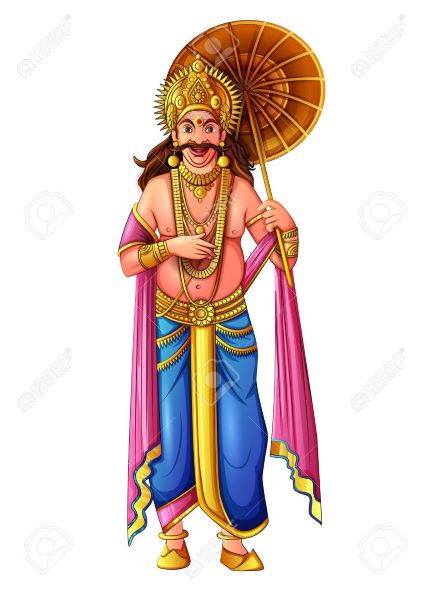
Some of you would not be aware of Onam, so before getting into the message of Onam, let me brief what Onam is. Onam is the traditional harvest festival of Kerala, the southern most state in India. The legend is that there was a king named Mahabeli alias Maveli, whose reign was the best Kerala ever witnessed, with the subjects living happily and peacefully. His governance was so spectacularly good that it convulsed the heaven with envy and that gods became restless, fearing that they would lose the tag of “the Best.” Hence, gods came together and decided to do a regime change in Kerala. As the people were on the king’s side, the strategy of evoking a popular revolt was ruled out. Also, waging a direct war to effect regime change was outside the realm of possibility for gods as it would make them look brutally unfair. So gods designed a plan and entrusted Lord Mahavishnu to do a soft ambush on Mahabali.

Mahavishnu took a new incarnation: Vamana and descended onto Earth, with a clearly-defined action plan of getting rid of Maveli. He visited Maveli and requested to offer three feet land. Looking at Vamana, the short, pigmy-height man, and without realizing it was a disguised-god who was out to put an end to his reign, Maveli immediately told Vamana to take three feet land wherever he wanted. And the moment he got the permission, Mahavishnu gave up the cover and grew to a mammoth figure revealing himself. With the first two feet of land, the entire earth and sky were covered, and there was no land left for the third feet that Maveli promised to give. Maveli, a man who always stood for integrity in his words and actions, immediately kneeled before Mahavishnu and offered his head as the third feet of land. Magnanimous, isn’t it? With no reported compunction, Mahavishnu put his foot on the head of the king and sent him to the netherworld. Before leaving the terra firma, the king asked for a boon — which was granted — to visit his subjects once in an year. Onam is the festival that the Keralites celebrate the annual homecoming of their once much-loved king Mahabali.

Amongst the many ubiquitousness of Onam, a folk song that details the goodness of the Maveli’s rule is much popular, and the message of Onam is embedded in it. The song in Malayalam language and its roundabout translation are as follows:

“മാവേലി നാട് വാണീടും കാലം 
മാനുഷരെല്ലാരും ഒന്നു പോലെ
അമോതത്തോടെ വസിക്കും കാലം
അപതങ്ങാര്‍ക്കുമോട്ടില്ല താനും 
ആധികള്‍ വ്യാധികള്‍ ഒന്നുമില്ല 
ബാല മരണങ്ങള്‍ കേള്‍ക്കാനില്ല 
കള്ളവുമില്ല ചതിയുമില്ല
എള്ളോളമില്ല പൊളിവചനം 
കള്ളപ്പറയും ചെറു നാഴിയും 
കള്ളത്തരങ്ങള്‍ മറ്റൊന്നുമില്ല ”

During the reign of Maveli
The people were like-minded
They lived with happiness
No danger struck anyone
Anxiety or diseases were absent
Never heard of infant mortality 
No lies or cheating
Not even a grain of lie-manufacturing 
No spurious weighing tools, nor deceptively under-volume measuring
Not any other kind of lies 

The people of his kingdom were happy and that there were no dangers lurking in the corner to strike them. When society is devoid of dangers of any form, there is no element of fear of unknown, and that is a prerequisite to happiness of people and wholesomeness of society. There were no dangers lurking because lies were absent — the people were truthful. There are two types of lies: telling the opposite of truth as well as telling manufactured-lies. The poet was intelligent enough to cover both these forms of lies in the lyrics. He corroborated the point of honesty by mentioning that no dishonest business activities through fake and spurious weighing and measuring — it must have been barter trade then — and the fair trade practices, the poet thought, were the best symbols of a honest people. The poet left no stones unturned to drive home the message of Onam, i.e., honesty. Honesty — enlivened by the absence of fear of lies — contributed to the sound mental and physical health of the people in the Maveli’s kingdom.

Honesty, the principle of telling truth, is the cornerstone of good governance. When honesty is the unwavering hallmark right from the top to the bottom layers of a society, it defaults a people of health and happiness. As Kerala celebrates the homecoming of its King Mahabali today, let’s resolve to create a wholesome society of health and happiness by inculcating the message of Onam: honesty in our thoughts and actions. Happy Onam!


Imaginary Fear

The most enticing thing in the world is success, for it is the culmination of man’s aspirations. So if you ask me, “What do you want in life?” my answer will be, “I want to succeed in life.” There are well-known and non-negotiable ingredients of success which, if man puts into use, will ultimately lead him to success. Goal-setting, determination, passion, hard work, perseverance, discipline, attitude of positivity and receptiveness are some of these success ingredients. There are also fringe elements like smartness, skepticism, perfection, correctness, ignorance, carelessness and jealousy which play no less important role as they have the potential to augment or derail man’s journey to success.

Apart from the ingredients and the fringe elements, one factor that we more often tend to overlook while talking about success is imaginary fear. Working in the opposite way, the inhibiting powers of imaginary fear are as much potent and all-consuming as the impetus and tempo generated by the success ingredients. In other words, imaginary fear and the absence of courage to act to nullify it are powerful enough to thwart or delay man’s progress to success even when he acquires and puts into use a perfect mix of the success ingredients.

Fear is a debilitating feeling arising out of absence of knowledge as well as presence of knowledge. This definition is apparently confusing as it accommodates two diametrically opposite sides. But it is only presumably so as I have deliberately used “as well as,” instead of the coordinating conjunction: and, to signify the fact that there are fear of known and fear of unknown. Both these fears are real and objective to a large extent. It is real because it is about something or someone for which some knowledge is present or absent — absence of knowledge is only want of knowledge but not non-existence of knowledge. There is another type of fear: imaginary fear whose existence varies from person to person as it is completely subjective.


Fear of known is based on the knowledge about someone or something, hence, gives the room to overcome it by another set of knowledge that can obfuscate the fear through remedial measures, so explicable fear is counterbalanced by the courage generated by equally explicable knowledge. Fear of unknown is based on little or limited knowledge about something or someone, so speculative and guesstimate thinking, bridled by intelligent-questioning — attempt to arrive at the answer by asking questions from all possible angles — in varying degrees, is involved in fear of unknown. On the other hand, imaginary fear has neither the support of the knowledge-base of fear of known nor the power of intelligent-questioning of fear of unknown. So we can quickly say imaginary fear as fear of unknown sans intelligent-questioning.

On the surface of it, imaginary fear stands with a simple definition of a fear that is not real. But a look at it in fathom reveals a more complex buildup. So the task of detailing imaginary fear is not much less than arduous. Imaginary fear is the fear generated by an image that is built on a false knowledge base. Human mind has the amazing power to create images out of a simple, single-line information about anything. It can weave a net out of a few meshes. But when the meshes used are of incorrect information or false knowledge that escaped the intelligent questioning of man, fear-creating unreal images are formed. Further fed by rumors, such images turn themselves into monsters living and thriving in his thought-process and frightening him without borders.

Imaginary fear is debilitating because it sucks confidence out of man. It can only grow from strength to strength because human mind is inclined to allow snowballing of false images, not vice versa, unless man makes deliberate attempt to obliterate imaginary fear. This is because images can keep themselves as they are or keep growing on our mind till they are confronted by one’s own volition powered by factual knowledge. So imaginary fear about something or someone lives and grows with man as he lives with them. Feeling that something bad will happen sooner or later, feeling that there was so much happiness in life so bad days will have to follow, feeling of an impending defeat even when all signs of success are in the offing, feeling that probability of doing things in an incorrect way is more than doing in correct way and feeling that oneself is a complicated person though one is actually not are some of the imaginary fears that man usually finds himself with.

What are the dangers of imaginary fear? Even when a man is physically fit and mentally balanced, if he is suffering from imaginary fear, then he scores low on mental health which can be defined as equanimity of mind with a positive outlook. Both fear of known and fear of unknown are contagious, meaning people around a man are susceptible to be infected by the fear the man expresses. For example, children, whose parents are habituated to get upset and go tense with various incidents in life and do not show courage to confront such incidents, are likely to have fear as a major element of their character as they grow up. On the other hand, imaginary fear is not contagious as it a hidden fear, with man hardly expressing it. This makes imaginary fear more difficult to address because we do not know who is or who is not suffering from it.

Imaginary fear destabilizes man’s thought process so much so that he feels like carrying an enemy whom he is unable to deal with. It maims and bruises every step before it is taken in the journey of life, condemning man to stagnate, if not degrow, for no other reason. The inhibiting powers of imaginary fear are so powerful that it frightens man of looking forward and progressing — stops mind from working in the way, otherwise, it would have — even when he is fully equipped to tread a successful path, for imaginary fear travels ahead of him, much before he takes the first step. Imaginary fear is like sleeping with an enemy whom man is clueless about.


How can man overcome imaginary fear? The only way to defeat imaginary fear is confront it head-on. In other words, batter and shatter the image that creates this unreal fear. But, how? Barring the omnipotent, nothing is omnipotent, meaning all earthly phenomena are packed with susceptibility to break, so is the demon called imaginary fear. If man can hit the baseless fear-generating image within him with the right tool, it will have no option but to fall asunder. And the tool is the knowledge powerful enough to prove the falsity of the image. So this knowledge has to be indisputable facts called truth. Only does truth have the all-consuming power to overwhelm and nullify imaginary fear. Whatever be the factor that creates fear-causing unreal image in you, grab as much factual knowledge as possible that can counter the raison d’etre of that image, and from the position of that knowledge-strength, question the imaginary fear without fear. As you do it, you will see the image falling dead before you like peeling the rings of an onion because imaginary fear is built on falsities, hence, can not weather the storm of truth.

Never do live with imaginary fear but confront it and eliminate it as it is second to none in stopping you from succeeding in life.

Credibility

The last thing a man wants to lose is his credibility. But, is it that which gets his first priority? If credibility is not the first priority for a man, then it cannot be that last thing to lose. In other words, credibility is not an accident but a default output of deliberate and consistent choices that a man makes in life. Since it is an output by default, it cannot be manipulated. Howsoever hard a man tries to hoodwink others about his credibility, he will ultimately fail in it as credibility is not an end in itself and that the means to the end were already set in by him.

What is credibility? In one word, credibility is trustworthiness. A man of credibility is a man who can be trusted for his words and actions — he will irresistibly abide by the meaning that his words expound and that his actions will be in congruence with his words. If we break the word: trustworthy, it reads worthy of trust. This element of worth is added to the variable: trust not overnight but over a period of time through a process where your belief in something or someone gets tested repeatedly. There is difference between trust and belief. Believing someone or something can be a one-off incident while trust is the intangible set of tried, tested and succeeded beliefs accumulated over a period of time. For example, when you buy a brand of soap or perfume or any product for the first time, you decide to believe in the benefits it claims to deliver, but these claims can be true or false. If they are true, your belief in the brand has succeeded, and if not, failed. The succeeded-belief will be tried and tested during repeat purchases over a period of time, and if each time your belief in the brand – belief in the benefits it claims to deliver – succeeds, you develop a trust in the brand. I do not believe what you say, and I do not have trust in you: these two often-heard sentences echo the not-so-subtle difference between belief and trust.

Trust is not a dead end but a live wire, meaning trust can be shaken and even broken. Trust in someone or something is shaken when your belief is tested and failed once while trust is broken when your belief is tested and failed repeatedly. Trust shaken can be repaired and restored while trust broken is broken forever. In order to elucidate further on the difference between trust shaken and trust broken, I wish to cite an incident without any prejudice to the protagonist in the incident. A few years back, CNN suspended the program: Global Public Square, or G.P.S., because in one of the episodes, the anchor and program creator was found to have done a little bit of plagiarism. I used to watch this program — and also after the incident – and the viewers’ trust in the program was shaken by this single event. Subsequently, the anchor apologized and the channel reinstated the program. Since it was a one-off incident where the viewers’ belief in the program was failed only once, the trust in the program was shaken but not broken. Had the probe by CNN revealed that the program was doing plagiarism over many episodes it would have made viewers’ trust in the program battered and shattered, leading to trust in it broken forever.

There are three factors: ideology, ignorance and credulity that have the power to make a man lose his credibility even when he has the noble intention of being on its side. Trust can sustain worthiness only when truthful actions emanate from a man. When there is tussle between truth and falsity in an ideologically charged environ, ideology forsakes truth if it is not in harmony with the tenets of the ideology. In other words, falsity gets a moral push under the cover of ideology and looks triumphed over truth. An ideology-wedded man, who is honest and trustworthy in the larger domain of life, does vouch for the ideology even when he knows that it is not in harmony with truth. Such repetitive aberrations from his otherwise trustworthy quality of consistently holding on to truth can make him a man whose credibility is seriously dented.

Ignorance does not make a man less, for it is not being aware of. Nonetheless, ignorance can cost a man heavily, including a hit on his credibility. However, the real danger is not ignorance but being ignorant about the ignorance, autopiloting a man to continue with his ignorant actions leading to the loss of credibility. Temporary setback to credibility from an ignorant action can be set right, but loss of credibility from continued ignorant actions is all but restorable. “You do not know what you do not know until you know it,” the famous quote sums it all about being ignorant about ignorance.

What is the biggest casualty of credibility? The answer is credulity. Credulity is the proclivity to assume that something is true. Being credulous, instead of seeking and verifying the veracity, can lead to actions bereft of credibility. After all, credibility is truth-centric. Assumption is a gateway to either truth or falsity with equal probability. But if you can replace assumption with presumption, the possibility of being on the side of truth is much higher. Presumption is informed assumption, meaning when truth is beyond the comprehensible spectrum, man tries to find the perceived linkages of truth and take decisions based on such information. The most damaging aspect of assumptions is that they have irrepressible powers to go incognito into the thoughts of a man and influence his thought process. And this can cause damage to his credibility without his knowledge because assumptions can be false, hence, the consequent decisions will fail against the yardstick of credibility. Ultimately, only will credibility be judged, not the assumptions behind decisions. Guard yourself against the proclivity to assume. Discard credulity and use the power of presumption as a way forward when truths are beyond the reach of comprehension.

It is within the possible realm to evaluate the credibility of a friend or acquaintance by the sheer fact of myriad opportunities of interaction with her/him. However, how do we evaluate the credibility of the words and actions of strangers with whom we have no option but to interact with for reasons of necessity? This is the most difficult part while dealing with strangers. There is no silver bullet to manage this difficulty except that we can take some quick notes of the person. In this regard, let me mention a couple of known psychological portrayals that are debatable either way. Over-humility is a sign of deception, and people showing such a character are highly likely untrustworthy. Consistent inability to look at the other person’s eyes during interpersonal interactions is a sign that a person is not straightforward and needed to be more cautious about — signs of lack of credibility. I have one point from my observations: People who possess the quality to laugh loudly are able to do so because they do not have a hidden personality and that they are not fearful that there is something untoward in their personality which might come out during their no holds barred laughter, thanks to their candid nature — a sign of trustworthiness.

I have to end this blog with the same sentence I used in the beginning of the blog with a small change: The last thing a man wants to lose must be his credibility.

Ease of Doing Life

Many of you will be familiar with the term: Ease of Doing Business, or E.O.D.B., an index that measures regulations which directly affect business. It has ten subindices like starting a new business, dealing with construction permits, getting credit, etc. with which the regulatory framework — hence, the consequent easiness or lack of it — of doing business in a country is evaluated and ranked. New Zealand, for example, has been consistently topping the list since 2017.

Is there a set of regulatory code of conduct for man that directly impacts easiness or difficulty with which he lives his life? This thought flashed my mind while I was reading an article on E.O.D.B. recently. Such a code of conduct ought to be there, for doing life with ease is not an easy thing and that it is highly likely that nature has postulated a set of criteria for man, like it did for other creatures, to do a life of easiness. Understanding those regulatory criteria can tell us where we stand with respect to the easiness that life offers; also, it can be used for midcourse correction if any. This, however, is easier said than done because though understanding the nature’s parameters of easiness is not an uphill task, practicing them is undoubtedly a difficult feat. Nonetheless, the scope for its practice is alive because many rightly say that life is not easy, as well as due to the fact that easiness and difficulty lie on either side of a single spectrum.

A universal truth that I am obliged to consider at this stage is that physical well-being, barring physical labor, is a consequence of mental easiness. Ease of Doing Life, or E.O.D.L., therefore, is the direct output of mental easiness. So the factors that have a regulatory influence on easiness in life have unfailing influence on our thought process. It is unfailing because not only does their presence have an assurance of easiness but their absence can also produce diametrically opposite and disastrous outcomes for a man. Hence, the regulatory framework of living a life of easiness is a proposition of live it or leave it, with no relative gray matter like in a black and white chessboard.

More clarity about the definition of easiness — hence, E.O.D.L — is required to further read through this blog. Easiness is the integral attribute that ensures wholesome flow of life through a logically consequent track when the related, guiding and binding variables are steadfastly met. So Ease of Doing Life is the life’s assembly line whose flawless movement is regulated by unequivocally established, non-negotiable and inherent factors capable of ensuring that when events and incidents happen, they pass out in their natural flow. These factors, like the subindices of E,O.D.B., form a set of criteria which we can call as the nature’s code of conduct for man. And they are forgiveness, honesty, integrity, righteousness and optimism. Let’s look in detail at each one of these regulatory codes of easiness, along with their possible linkages.

Forgiveness is the capability to absorb, neutralize and disperse injustice meted out by others by overcoming the feeling of retribution. It is a win by man over himself, independent of who causes injustice to him. The most striking saying about forgiveness is this: forgive and forget. Forgiveness is complete when you can forget the incident for which you forgave someone. But man has a penchant to not completely disengage himself from the past sour incidents even after he walked past them, so it is possible that the sour incidents can inadvertently flash through his mind. Along with forgiving, if you can completely forget the incident, then it is the best service you can do to yourself. However, if you succumb to that flash through the memory line, and as long as the flash disappears at the same speed with which it hits you, you are as good as a person who can forgive and forget. In this context, it is interesting to look at the difference between history and past-history. When an incident is buried beyond the redemptive powers of memory, history becomes past-history. If you can convert the history of sour incidents into past-history, then you have mastered the art of forgiveness.

The virtue of forgiveness offers plateful of returns beyond man’s expectation. It gives man equanimity of being at ease with himself, a prerequisite to be at ease with his surroundings. Forgiveness gives man more time for himself — to plan and do things for his future — by freeing him from wasting his valuable time in preparing plans of retribution. The eternal contribution of forgiveness is it gives man the feeling that he has no enemies in this world because his mental-make is such that anyone who considers himself/herself as his enemy and does harm to him ceases to be an enemy as far as he is concerned — injustices will be absorbed into and neutralized in the default pot of forgiveness, so his ease with himself will be nonchalantly protected.

Honesty is the principle of telling truth. Being honest or not is a personal choice and has its consequence; this consequential effect is a regulatory factor that generates or degenerates Ease of Doing Life. We need to differentiate between comfort and easiness as both are not one and the same. Let me illustrate the difference by asking a question: are you comfortable with being dishonest? If the answer is yes, it means that you can comfortably live with dishonesty, but that does not mean that this comfort can bring easiness in your life for, otherwise, there is no room for realization for a dishonest person. Indisputably, dishonesty can give comforts, but these comforts will always have questions seeking the reasons for their existence, and the inclement answers for these questions have the potency to take the easiness out of the comforts. On the other hand, easiness that honesty offers is non-subsiding and non-disappearing because it does not accompany ruffling questions.

Integrity is that part of your being without which you are as good as walking dead. It is something with which man identifies himself, so does the world. Integrity is the repository of elements that stems up the values with which a man operationalizes his character. In short, integrity is the base on which all other virtues are built up. It is impossible for a man to be honest or ethical after compromising his integrity. Integrity is the foundation of values that form the DNA of man’s character. It regulates your behavior as much as you allow it to do so, meaning if a man is a man of integrity, he is bound to attract and reflect all other virtues of goodness, guiding the life to move through the natural path of easiness.

Righteousness is the judgment based on facts, so it is irrefutably objective. Righteousness does not need a reason to exist as it is the reason by itself. It is the yardstick to segregate the deserved from the undeserved. Righteousness is so important a factor that its absence is tantamount to a man without soul. The Holy Bible asks, “And what do you benefit if you gain the whole world but lose your own soul?” The answer is nothing as man becomes a thinking machine of flesh and blood but hollow from inside if he loses the soul. Righteousness is the soul’s regulatory intervention to guide man along the path of truth in the material world.

Optimism is the practical side of hope. It is the energy drawn from the hope for a better future. Hope, even when it is a ray, creates so much energy and enthusiasm that man tends to forget the drudgery he is in. Optimism does not optimize the radiant energy from hope, rather it is the maximization of hope in present value terms — so optimism is the net present value of hope. How does optimism have a regulatory influence on man? To get up in the morning and begin the day on a positive note needs something to look forward to — the hope of a good day or the feeling that something good is on the way for you. That optimism has a huge bearing on how a man conducts himself during the course of a day.

Though these regulatory attributes of life of easiness are not mutually exclusive, effectiveness of each one has a considerable peripheral influence on others. For example, without possessing integrity, a person’s penchant to be honest can be debilitated because honesty is most tested when it is least demanded. Similarly, it is possible of being honest without being righteous, but man can never be righteous without being honest. Forgiveness and optimism are indirectly linked as forgiveness can kill pessimism, and when pessimism is dead, it is most conducive for the seeds of optimism to sprout. Irrespective of counting or discounting the linkages among the five factors for Ease of Doing Life, each one offers its own share of easiness when man puts it into action. Which of the attributes gives more or less easiness is only an academic question, but each gives energy to live life with easiness.

It will be an incomplete attempt if I try to give numerical value to human virtues. However, to draw a parallel with E.O.D.B., let me assign nominal values to the five factors of easiness. Unlike the subindices of E.O.D.B.. the factors of East of Doing Life can be given nominal values of only 1 and -1 as the highest and the lowest metrics respectively because they are characteristically come under ‘either or’ clause. You can be honest(1) or dishonest(-1) with no option of being a partially or occasionally honest person as similar as there is nothing called half-truth, for truth is absolute. Similarly, you do or do not have integrity; you are optimistic or pessimistic; and your sense of righteousness is either operationalized or shelved. So a numerical value of 5 is the best score for Ease of Doing Life, and -5 being the worst. Here, the positive and negative scores do not neutralize each other, meaning loss of easiness of one factor, say, righteousness, can not be compensated by the easiness of the another factor, say, honesty. For example, a score of 3 is always accompanied with -2 in a non-neutralizing combination: similarly, 2 and -3, 5 and 0, etc. Lower the positive score, lesser the easiness of life man enjoys. And a minus 5 score completely scores out the easiness that life offers. On the contrary, when a man scores a rank of 5 across these factors, he unquestionably and impeccably lives with the easiness life offers.

Life is not easy and has given us the tough task of finding and following the unflinching factors of easiness to live with. So Ease of Doing Life is a choice whose efficacy is regulated, hence, guaranteed when man lives his life under the guiding factors of forgiveness, honesty, integrity, righteousness and optimism.

Message of Easter

Many of us will quickly answer: ‘Easter eggs’ if asked to tell something special about Easter. I am not sure how many will be able to answer the question: what is the message of Easter? Easter is 2021 years old, so is its message. No one will have any doubt that Easter is the celebration of the sacrificial death as well as the resurrection of Christ. Some may raise questions about His rise from the death, and it is okay to do so, even such a question will be all right with Jesus. Christ’s resurrection unequivocally establishes that he is the Son of God. Nonetheless, the message of Easter is embedded in the sacrificial death.

If you read the New Testament of the Holy Bible, then you will notice that the biggest miracle Christ did was that He never did any miracle for Himself! He did many miracles: healed the sick, raised the dead man Lazarus and brought him back to life, fed 5000 people with five loaves and two fish and so on. But Christ did not do any miracles for Himself, including saving Himself from the painful death! Why? Had He done any miracle to save Himself, the very purpose of His journey to earth would have been defeated, and we would not have been celebrating Easter as it then carried no message.

How did Christ die?  We know the answer is  crucifixion. Yes, but if we go a bit deep into His death on the cross, He died from the inability to breathe. When a man is hanged with his hands stretched out and fixed to and legs affixed on a cross for a long period of time, it will be difficult for him to breathe because the functions of lungs will be severely impaired.

As He gasped for breath and took the last breath before leaving the world, Jesus said, “Father, forgive them, for they do not know what they are doing.” The message of Easter is forgiveness, and it is the essence of Christianity. Christ told his followers to take the cross and follow Him. The cross of forgiveness, and this journey is not an easy one but very painful. If someone slaps you on the right cheek, turning to him the other also needs ability to accept the physical and mental pain with calmness and without any tinge of vendetta, even in the thoughts. And that ability comes from forgiveness.

Even if you are able to memorize the whole Bible and even when you are a frequenter of churches as well as an active member of church activities, if you are not carrying the cross of forgiveness, you are no way near to Jesus, who will tell you whenever you meet Him, “I don’t know you.” He will show you your name missing from His supercomputer. Throughout the verses, He emphasizes forgiveness. If I am allowed to paraphrase one such verse, it goes like this: When you come to the place of worship to offer prayers to me, if you still have enmity toward your neighbor, leave the offerings at the worship place, go to your neighbor, forgive and reconcile with him, then only will I accept your prayers. Christ taught only one prayer to the people around Him, and it was a prayer to the Holy Father. I am afraid to recite that prayer because it has a sentence “… forgive us our sins as we forgive those who sin against us…” So when I recite this prayer, I am telling God to forgive my sins the way I forgive those who did bad to me. Do I forgive people? If not, my sins will not be forgiven. What a sentence to ponder on!

I wish you all Happy Easter. May the virtue of forgiveness take root and flourish in you!

Inherent Differences of the Astonishing Similar

There can be similarities between two things or two persons but never sameness. For example, even when they have so much morphological similarities that make them not easily distinguishable physically, identical twins have two physical marks: retina and fingerprints whose scrutiny can reveal their individual identity, hence, uniqueness. Uniqueness is the nature’s way of telling that everything and everyone are different, with each having a raison d’être. This nature’s rule is all-pervading across both tangible and intangible things — every physical as well as non-physical existence has unique individual identity. Uniqueness is a sign of difference! In this blog, I am looking at a couple of these inherently different yet strikingly similar intangible twins: strength & health and education & learning.

Are strength and health one and the same? They are not, and even though they have similarities, each possesses uniqueness that makes it different. Strength of a man is the sum total of his physical and mental powers, and health is the sum up of his physical and mental well being. In other words, being in a state of physical and mental wellness is health while strength is the harnessed-power of body and mind. Strength can contribute to health, but strength alone is not health as the latter has additional contributory elements to it.

Wellness is being in harmony with oneself as well as with the surroundings. Mental wellness is the reflection of what goes into your thoughts — healthy thoughts produce a mind of wellness. Mental wellness is a prerequisite for physical wellness. Sweating it out at gymnasium can make you strong but not necessarily healthy; keep your mind in healthy thoughts, your body will follow. A man, through his deliberate choice of harmony over disharmony for his mind — hence, consequently for his body — will also clock harmony with his surroundings.

Elon Musk is a global icon of breathtaking entrepreneurial skills and disruptive thinking. One such innovative thinking: he is ready to recruit a school dropout for a high-profile job provided that the person demonstrates deep learning of the subject, which Musk tries to understand by asking intelligent questions that also include the ones unrelated to the functional domain.

“There is no need even to have a college degree at all, or even high school,” Musk said in 2014 during an interview with the German automotive publication ‘Auto Bild’ about his hiring preferences. He is saying at point-blank that education is not relevant but learning is. With such an approach, Musk is looking for a ‘learnt person,’ not an educated person, and the underlying assumption behind this approach is that education and learning are not one and the same.

Though there is some level of clarity about their distinguishability, many fall prey to the ambiguity and do mistake learning for education. Education and learning are not one and the same as education is only one of the ways toward acquiring knowledge — the end result of learning. But it is not necessary that an educated person is a learnt person. That is why we call someone, who possesses knowledge and demonstrates it through intelligent thinking and wise decisions, as a ‘learnt person,’ not an educated person.

Nothing stops an uneducated man from learning from his experience and turning himself into a learnt person while it is possible that an educated one can miss learning from the education and continue to live a life of educated-ignorance. Why so? Because getting educated is a social obligation thrust upon a man by his kith and kin while learning is an individual choice.

Learning has two steps: acquire and learn from knowledge; and learn from the learning. One needs to travel from the first step to the second step through volition and practice. The second step is highly rewarding as it is the place where learning keeps all its valuable trophies. Learning from the learning gives a man the power to understand a different, brand-new and difficult situation easier and faster. All the wise quotes and philosophical discourses from the luminaries of yesteryears are the results of the learning from the learning.

It is a default design of our character that we notice and take note of the differences — uniqueness — among the tangibles even when they have astonishing similarities but often miss the uniqueness of intangibles. It is difficult to exhume the uniqueness of intangibles, for they do not come in shapes and sizes but as concepts, with only virtual existence in our thought process, resulting in a situation where we might mistake one for the other. Such mistakes come with a cost, sometimes heavy, on us as we hardly realise the wrong selection, hence, keep living with something though the actual requirement is something else. This may be damaging as ‘that something’ not only can not meet our needs but also gives us, without our cognisance, a pseudo-satisfaction of correct selection.

Lies Incognito

Even when man is scrupulously being on the path of honesty, he can be hoodwinked by lies-incognito and be made to feel comfortable with them though he is not conscious about such quick conditioning he undergoes. This thought struck me when I came across the news that North Korea had hacked the Pfizer computer systems to get access to the vaccine secrets. In the news, I could not see the word: steal or its synonyms, with the the explicit tenor being trivialising the issue, as well as glorifying North Korea’s hacking abilities. So I was initially comfortable with the news and did feel praiseful of North Korea’s hacking prowess. Then, it suddenly flashed my mind that I was being okay with the news of stealing — beautifully masked in the term: hacking. The most common forms of lies-incognito that try to sway us are favours, sycophancy and convenient-thinking.

Favors are takeaways or giveaways that defy natural reasoning. In the context of favour, reasoning has two dimensions — natural reasoning: credits go to where they are due; and preferential reasoning: credits go to where the giver’s preferences point him/her to. So favours are the outputs from the triumph of man’s partiality over natural justice. Let me bring in God, the embodiment of natural justice, into the picture and illustrate an imaginary situation as follows;

There are ten candidates for one job position, and out of the ten, five are believers. All the believers prayed to Him before the interview. Now, whom will God prefer for the job? The believers? If yes, which believer? Or, will He prefer non-believers? Or, will God do nothing and let the natural reasoning of the most meritorious candidate take home the job? Whatever be your answer to these questions, it is to be noted that God is truth and justice, hence, an edifice of natural reasoning.

Favors are lies sweetened enough to fail us in discerning the preferential reasoning behind them. But if you think a bit deeper, then you will realise that sweetness begins at the point where bitterness ends. Hence, it is not impossible to pause and take a bitter call on favours.

Sycophancy is serving a man’s false-pride through lies which comprise both non-existing facts amd inflated or deflated facts. Lying is of two types: telling things which are diametrically or partially opposite of the existing facts; and manufacturing lies and presenting them as facts. Sycophancy is different from praising which works on the basis of cause and effect, meaning for every praise a man gets, there is a compelling and deserving reason behind it. On the other hand, sycophancy does not have a corollary reason for its existence. It stagnates a man because it feeds his false-pride which is a bigger hindrance to progress in life. False-pride is the inability of a person to accept reality and behave, accordingly, prompting the person to over do beyond the wherewithal in his/her possession. A man of pride will not tolerate sycophants around him, but one with false-pride fails to discern them. Unfortunately, we have more people possessing false-pride than those who hold pride.

We have a proclivity to convenient-thinking. Given a few choices, most of us will choose the one that is convenient and advantageous for us. Although the argument of being rational can be put forth, we often fail to discern facts in such situations. I will illustrate this with an example: Suppose that you have got a PCR positive result in a Covid-19 test and that you are completely asymptomatic so have decided to quickly do another PCR test that gave a negative result. Between the two diametrically opposite test results, it is highly likely that you will accept the negative result because that is convenient and advantageous for you. And in this process, you fail to think in this way: one of the test results was wrong; which one was wrong, the first result or the second one? Unlike favors and sycophancy that are external, convenient-thinking is an endemic flaw of our character, hence, does need a lot of recalibration in our thought-process to overcome it.

Why do lies come incognito? In other words, why do lies-incognito have acceptability? The single most overriding reason is that they have a facade of semblance of truth, hence, can be perceived as truth, thereby tricking even an honest man to accept them as truths. Lies-incognito are flavoured lies and very attractive but not irresistible as many honest people repudiate them. And, how do they save themselves from getting tricked by these truth-resembling lies? In their thoughts, they remove the top layer of flavours covering the lies and discern the lies lying flat on the back. Unless this thought-process happens, it is highly likely that even an honest person can be tricked into by the lies-incognito. It is difficult but not impossible to lead an honest life, and that difficulty is exacerbated by the unseen enemy called lies-incognito. Beware of lies-incognito!

This is my 100th blog, and I am thankful to all the visitors to and readers of my blog.

Respect

What is that one thing that man can effortlessly give to another? It is possible that elements like love, money, time, etc. would have flashed your mind had you paused for a while to ponder over the question I raised. I am sure that most of you had come across the term: unconditional love. Whether it is possible to give unconditional love or not is a moot point, and the answer in either way demonstrates that a lot of investment is needed in order to give love. So giving love is not effortless. Money, one of the few exceptions to Diminishing Marginal Utility, is, though not the last thing to give up, not an easy commodity to part away with. Lesser amounts of money for global charity works as compared to the wealth getting accrued to the rich and the new-rich is a testimony that money is a hard-to-giveaway article. Those who know about the value of time rightly and wisely choose where to invest the limited time available. The fact that we are largely configured with a 3-stage cycle of sleep, work and recreation in almost equal scale, investing 8 hours available under recreation in our likes and dislikes is a judicious decision. It means that our time is also not easily and effortlessly available for anyone. So, what is that which we can give effortlessly to anyone? Respect. Yes, man can effortlessly give respect to others. 

What  is respect? Or, how do we define respect? Respect is honoring one’s own commitment to the norms governing human values. Respect is also honoring others’ commitment to the norms governing human values. If we club these two, respect is honoring one’s own commitment as well as others’ commitment to the norms governing human values. So it is clear that respect has two dimensions: self-respect and respect for others, and the former is a prerequisite for the latter. It is highly unlikely for a man to respect others — their values — if he does not respect himself — his values. In the same breath, we need to understand that it is not possible for a man to have a set of values, still, not honor them because the only sign of life that values possess is the honor with which they are upheld. Values are sitting-dead if they are not upheld. The elements of value system that man has to have in order to keep himself on the default track of self-respect mode are honesty, righteousness, humility, kindness and similar virtues of goodness.

Though understanding increases the level of respect, it is not necessary that someone has to understand someone else to show respect toward him or her. Manifestations of respect are acknowledgment and appreciation. Acknowledgement is making the other person aware that you have taken note of his/her presence and that you are willing to listen to him/her. Appreciation is one step ahead from acknowledgement, where you recognize and applaud the goodness and achievements that the other person had brought onto the table. Only can a man who acknowledges and appreciates the goodness in him show the willingness to honor the goodness in others. In other words, those who cannot acknowledge and appreciate, i.e. respect, others have their own values sitting-dead inside them. 

Unappreciative mind as well as appreciation bereft of enthusiasm — half-hearted gesture — possibly reflect an element of jealousy. To appreciate others, man needs a lot of courage to overcome the inbuilt inhibiting element called jealousy. Jealousy is a big hindrance to progress in life; it ties down a man to the narrow confines of his mind, where he, instead of competing to acquire the attributes of success, gets obsessed with his limited knowledge about others’ success, thereby absenting himself from exploring the times that offer opportunities for progress. It is impossible to fake ourselves because our subconscious mind takes inside and responds to the dominant thought dwelling on the top of our mind. You may have experienced that irrespective of your desire to have a positive mindset, you often tend to have the opposite. This happens when the strength of the negative forces like jealousy is more than those of the positive desires. If you want to be a man of virtues, you have to be a man of virtues as there is no other go — you can possibly game all but yourself.

Appreciation, the integral soul of respect, is also a two-way journey as it gives a return in proportion or more to the investment you put up for it. For example, if peer jealousy can be replaced with appreciation, then it has the potential to be a powerful factor that motivates you to succeed in life. Let me explain this with an example. Our life is like a river. All rivers get born in the mountain-highs as pools of water, and in order to become rivers, they break their way out through hard rocks as streams, take a plunge of thousands of feet down along the rocky mountains, land on plains with cuts and bruises. Yet they quickly organize themselves to begin the new journey as rivers. As stream begins new journey and flows down the plains, it grows in length and breadth as tributaries get added to them, finally, becoming a full-fledged river. We are all pools of waters as we begin our life. As we flow, tributaries of knowledge get added to us, and we become rivers of length, breadth and depth, churning out fertile soils from underneath – the fertile soils of life’s reflections as we experience. Why do some people continue to remain as pools of water while others stream out and flow as rivers?

The internal pressure generated from the success ingredients is the force that breaks the hard rocks of life’s tests and tribulations, enabling us to stream out from the pools of our self-inflicted limitations. But this internal pressure will be created only if we are on a positive mental framework which also includes acknowledging and appreciating the feats of streaming out by our neighboring pools. We can learn from their success — how they managed themselves to stream out to become rivers — and use such learning as an impetus adding to the internal pressure. But for this to happen, our dominant thought should not be jealousy but of showing respect toward the success of others — acknowledging and appreciating their feats.

As we all know, change is inevitable, but changing oneself is neither inevitable nor unavoidable but optional. Over the years, we change physically by growing older, but that does not guarantee a transformative change in emotional and mental spheres. Unlike physical growth, growing mentally and emotionally is tumultuous and painful, but it is a regenerative process where you molt and shed off the inherent inhibitive and unwholesome habits that stagnate you in the pool and adorn new traits that commensurate with or exceed the physical growth. It is a transformative change involving sprouting of positive mindset. Do make respect — acknowledging and appreciating — for others a part of your mindset as it adds value to and hasten your own progress in life.

Rio de Janeiro

There is no exaggeration that Rio de Janeiro is known as Cidade Maravilhosa or Marvelous City as it is one of the most beautiful cities in the world! Its magnificent mountains dotted in the vicinity of beautiful beaches are enough to justify the marvelous nomenclature. I was fortunate to have visited the city two times, in 2010 and 2011, and both times, my friend, Jamil, was magnanimous enough to take me around the city to explore its myriad beauties. The attractions of Rio, as tourists fondly call the city, are many — Christ the Redeemer, Copacabana Beach, the Catedral Metropolitana de São Sebastião; Sugarloaf Mountain and so on.

Jamil:

For the city inhabitants who constitute the Brazilian ethnic mix of European, African and mixed ancestries, mountaineering is not only a sport but also a pastime. Tourists take a cue from this and also join the folks. I, too, went for hiking a mountain named Morro da Urca with Jamil, and there were pathways and unmarked highs during that uphill journey. The mountain has an elevation of 722 feet, and we took around 2 hours, I remember, to reach the peak. From the top of the mountain, the views of Rio are stunning!

The climb was strenuous but enjoyable. I am as pictured after the climb, and Christ the Redeemer is visible in the faraway mountain backdrop:

While resting on a mountain peak, it is not uncommon that you could possibly sight a group of hikers popping up beside you. I saw the following hikers as I was resting after reaching the peak where Christ the Redeemer was located:

Skipping a visit to Christ the Redeemer, one of the Seven Wonders of the World, while being in Rio is unthinkable for a tourist, so I also visited the iconic symbol of Brazil. There is train service from the plain to the mountain top, but on the day of our visit, there was a long queue of commuters; hence, we took taxi to the statue located on Corcovado mountain — 2300 feet high — in the Tijuca Forest National Park. The 98-feet statue of reinforced steel and soapstone, created by the Polish sculptor, Paul Landowski, and built by the Brazilian engineer, Heitor da Silva Costa, is mounted on a 26-feet pedestal, and Christ’s stretched-out hands have 92 feet width in between. After alighting from the taxi, we walked uphill for sometime to reach the statue. Though 10 years passed by, the feelings of wow and exhilaration that I experienced while being at the mammoth sculpture are still palpable in me. The visit to the site is one of the cherished moments of my life.

A beautiful 4-km confluence of land with the Atlantic ocean, Copacabana Beach is a happening place brimming with onshore and offshore activities round the clock. It has vast beachfront area where people engaged in sports like beach volleyball, cycling jogging, etc. could be seen day and night. Canoeing in the immediate offshore vicinity is a common sight during daytime.

The views of the majestic seaside mountains from the beach are extraordinary! I had many standstill-moments as I got consumed by the towering beauties that stood tall and sprouting out of the water!

Forte de Copacabana, situated at the southern end of the beach, is a military base and does house a military museum. It is open to the public. The fort was built between 1908 and 1912 by the Brazilian Military.

Copacabana beach has a colorful nightlife with clubs, pubs and restaurants located in and around the beach. Along with a few friends, I visited a salsa club.

Rio is the first place where I had seen something unique in restaurant business: diners need to pay in advance in accordance with the weight of the food they chose to eat. It is followed in buffet where one can choose any food — including fruits, chicken, meat and fish — available on the table, get it weighed and pay as per the weight, so one price for all types of food. In this process, people, I noticed, did not waste food as they had to pay for every bit on the plate. It is a good system to prevent food wastage. I had seen such buffet system of weigh-and-pay also in countries like Argentina and Bolivia.

A few random clicks from the city:

Another hard-to-miss attraction in the city is Sugarloaf Mountain, which derived its name, it is believed, from its resemblance to the traditional shape of the Brazilian concentrated sugar loaf. Brazil is one of the largest producers of sugar in the world. To reach the mountain which stands 1299 feet high out of the water, one needs to take cable car. The cable car, built in 1912, is an engineering feat of international acclaim and runs along a 4600 feet route. It starts from the base of a hill-station named Morro da Babilônia, then, has a stopover at the mountain Morro da Urca. Passengers do not have to alight from cable car at Urca, and I think the stopover is an engineering requirement.

Sugarloaf Mountain is a monolith, meaning a single rock, sprouted straight out of the water. Geologically, Wikipedia says, it is considered part of a family of steep-sided rock outcroppings known as non-inselberg bornhardts.

On the way back, getting down at Morro da Urca and spending time at this peak are irresistible attractions of this outing in the sky. There are coffee shops and restaurants at this peak. And witnessing sunset from Urca Mountain is an awesome experience!

Roadside entertainments and funs are the untold elements of the city’s hospitality:

Overall, I had wonderful times at Rio, thanks to Jamil. I still cherish all those nice Rio moments. If you ever get an opportunity to be in South America, do not miss to make a trip down to Rio as it will be more than worth the time and money you spend. The icing on the cake of a visit to Rio is witnessing Rio Carnival, during which the city will be adorned with men and women in colors and costumes that challenge one’s imagination. I have not had an opportunity to be in the city during carnival time, so I am looking forward to have a trip to the city during such a jamboree.

Simple, Complex and Complicated

On facebook, I come across people who show their relationship status as “it is complicated.”  It is a fact that this is a willful selection by them as facebook does not give it as a default option. So being in a state of complicated is man-made. Why does not facebook have a status option of “it is complex?” Complexity is naturally occurring while being in a complicated state is artificial. So we have an option to not complicate our life, and at the same it is inevitable that we need to pass through the complexities of life. Simplicity and complication are two modes of life, and which mode is to be chosen is a man’s decision. This decision has a large bearing on how he carries on with his daily life so on his life itself. A downside part of this selection is that many fail to understand correctly the complex elements of life, resulting in them leading a life of complication, instead of simplicity. In other words, a man misses simplicity to complication when he fails to learn the elements of complexity.

We are used to the saying: “keep life as simple as possible.” What does this mean? Many people lament that life is never easy for them. And that stands correct as life is not simple or easy, but it can be made easy and simple. In the same breath, life is simple and can also be made complicated depending upon what a man does with and in his life. Hence, it is possible to have simplicity in life without getting it complicated. So, what do we have to do to have a life of simplicity?  In order to move further on this, we need to understand the meaning of each of these terms: simplicity, complexity and complication as well as the linkages among them. Though they seem to be diametrically opposite, simplicity and complexity are related to each other in as many ways as possible. Complexity, in fact, is the way to simplicity and vice versa. For easy understanding, let me make two statements: life is as complex as simple, and life is as simple as complex. Although they sound different, complexity and simplicity, in the ultimate analysis, share the same thing. And failure to understand the nitty gritty of the relation between simplicity and complexity leads to the state: life is complicated.  

Simplicity is the way that offers the shortest space and time to reach the natural setting. In other words, a life of simplicity means that a man leads a life of being in harmony with his natural settings without inimically manipulating them so that he can understand and is understandable without any discounting or inflating. So there cannot be any “short of or excess” in the realm of simplicity in life. Albert Einstein stated that the shortest distance between two points is not a straight line. Simplicity, though has the shortest space and time in its amphitheater of understanding, does not offer everything straight on a silver platter but comes as strings in the webs of complexity. So complexity is a web of simplicities but intertwined in all the possible permutations and combinations, thereby making it difficult to untangle and understand it. Though the task is difficult, sometimes extremely difficult and looking impossible, it is still possible to accomplish unravelling of complexities because complexity is ultimately a web of simplicities. I will illustrate this with a couple of examples from Mother Nature.

Nature’s complexity has a mark in all its creations, but it always kept simple ways to understand its complexities. But finding these simple ways is as complex as the creation itself. Food Web is a complex network of food chains, and a Food Web is too complex to understand unless we go through the related food chains. A lion hunting a bear or a snake preying on frogs does not have direct connection with the food on our tables. But our food chain is definitely meeting the food chain of frogs and snakes through the insects and weeds at paddy fields and other crop fields. However, if we do not understand and learn from the complex web of these food chains, then our Food Web, which comprises innumerable food chains that have countless animals and plants with no direct contact with us, can be in danger. For example, plastic pollution of oceans and seas can destroy many fauna and flora which have no direct connection with our food chain though they could be the members of our food web. Unless we understand this complex web of connections that our simple food chain is linked to, we are not understanding the complexities of leading a simple life that offers sustained supply of foods on our tables.

Another example is the Universe. Starting with our planet Earth, the other planets, the satellites and the sun of the solar system which itself is a member of the galaxy Milky Way, the Universe is a complex web of galaxies of stars, planets and other spatial objects — all following a definite pattern showing the Universe in its simple yet complex dimensions. Science tries to unravel these complex webs by understanding the simple building blocks and patterns of the complex Universe.

Coming back to the issue of people having relationship status: “it is complicated,” they chose to be in that state because they have not understood the simplicities that form the web of complex human relationships. Looking at this issue directs me to the question I earlier raised: what do we have to do to have a life of simplicity? Being in a complicated state means that the person is not able to understand the dynamics of complexity. He/she fails to see through the curtain of complexity by not understanding the elements of simplicity with which complexity is made of. And the resultant situation is ambiguity and confusion leading to a debilitating state of painful indecision called “it is complicated.” Whether it is a marital discord or dealing with a troublesome neighbor or official drudgery, one can get out of the complicated situation by understanding the web of simplicities that form the complexity of the particular situation. Such understanding clears ambiguity and gives elbow room to take decisions lifting you out of the complicated state. Do understand that if you are in a complicated situation, it is made by you, hence, can be rectified by yourself by diving down into and understanding the web of simplicities that forms the complexity, failing of whose comprehension led to your complicated situation.

Try to lead a life of simplicity because it is the most harmonious and seamless way to experience life in its natural setting, and in this process, you will tame complexity and avoid being in a complicated situation.

Proportionate Growth – A Learning from International Business

James Allen is one of the thinkers who influenced me in a big way, and his thoughts are pearls of wisdom — detailed in his book: ‘As a Man Thinketh — which played invaluable contribution to my life’s progression. Amongst them, this one: “Man is a growth by law” has profound meaning. In this aphorism, he says something without telling it though a careful reading of the book evidences its presence felt, and that is the word: proportionate. The growth needs and ought to be a proportionate one, for it is a nature’s rule applicable to every creature without exception in order to experience a wholesome — balanced — living, Hence, man is also bound by this Hobson’s choice if he wants to live a life of wellbeing. The rule is equally applicable to a system if it wants to have a sustainable growth. James Allen’s words crossed my mind as I confronted an operational challenge in my profession.

For the last few months, our company has been experiencing a major stumbling block in the export business: lack of enough shipping space to accommodate containers to various destinations. Almost all the shipping lines had cut down their sailings and/or pooled their sailings together to minimize voyages on various routes and also had replaced bigger ships with smaller ones leading to a situation where getting a container-berth on a ship had become an extremely difficult and long drawn process. This is resulting in a situation where we are not able to ship out the goods within the targeted month and that the shipments have to be rolled over to the next month. The case is further exacerbated by the congestions at various seaports. Though our problem is micro when drawn on a bigger international business canvass, if I am allowed to look at it as a matter of fact from our side, then I can say that our growth as a company is temporarily stymied by a single element of disproportionate growth of the shipping industry.

To make it easily understandable, let me illustrate how this challenge of a macro dimension affects a country. India had done a bilateral trade of US$ 145 billion with the United States of America in 2019, and India’s Commerce Minister recently set an ambitious target of US$500 billion bilateral trade with the States as doable in the next five years – an annualized growth of 28% which, as the minister said, is achievable. Similarly, India has set ambitious trade targets with the United Arab Emirates, Indonesia, the EU block, etc. What does India have to do to achieve these ambitious targets, with a larger economic objective of pushing up exports more than the level of imports as India is currently a trade-deficit country?

Well, India has to make many business-friendly decisions with regard to its macroeconomic policies to enable increased investments in infrastructure; liberalization of polices to encourage value addition through manufacturing; being more open to inflows of foreign capital as well as technology; beefing up its service sector to face increasing competition from countries like the Philippines, Vietnam; etc. Imagine that India has done all these, besides, complied with all the bilateral obligations with perfection, but barring force majeure, will it surely lead to India achieving the trade targets? Till I confronted the operational problem, I thought that the answer to this question was yes. But the problem shows me that the answer is a no because there is another element called logistical infrastructure that also needs to grow in tandem — grow proportionately — with the growth of the macroeconomic measures that India undertook.

In order to achieve its stated trade targets, India needs to invest in its ports and affiliated infrastructure so that bigger mother ships can call at Indian seaports as well as frequency of sailings through the Indian trade routes can go up. Furthermore, to avoid any logistic shocks, India should encourage domestic shipping liners to strengthen their international operations, especially in establishing direct sailings from India to the trade-targeted countries. In a nut shell, India needs to have proportionate growth in all the elements, including its logistic infrastructure, that are intrinsic and inevitable to achieve its stated trade goals.

Allen’s words are a living testimony if we look at how nature grows its creatures. Nature does its wholesome act of proportionate growth in perfection. Let us look at the way a tree grows. The time from its sprouting to the phase of aging out, a tree grows in length, breadth and depth to maintain its wellbeing that enables its survival through the life cycle. And this wellbeing is achieved by the proportionate growth of its body parts — branches grow, sometimes stretch themselves out, to get required sunlight, roots go down as tap root or spreads out horizontally in fibrous to have enough hold onto the ground and trunk firming up to make itself a strong body — all happen ‘in the order’ as required by nature to have the beauty and balance to maintain itself as a tree. This proportioning of growth is applicable for even inanimate things of natural origin, and storms are a classic example of this — the seed of a low pressure region surrounded by a system of high pressure growing in leaps and bounds in proportion to the pressure gradient.

Coming back to the aphorism that man is a growth by law, with its larger meaning of proportionate growth, it is imperative that man grows in all his natures in a proportionate way to experience a life of wholesomeness. In his book, ‘The 7 Habits of Highly Effective People,’ Steven Covoy elucidates this point emphatically, and I am paraphrasing his words: Man needs to grow physically, mentally, emotionally and spiritually in the right proportion in order to have these four natures coexist in a balanced mixture without one overriding the other. This balanced growth is a prerequisite to have a life of wellbeing; otherwise, states like these can arise: man can be brutally analytical and miss the holistic view, meaning he can be grown to a being guided only by reason, leaving emotions unattended; it can be other way round, too, — totally emotional with no room for reasons. It can also be ignoring the bodily requirements like sleep, rest by working for longer hours to satisfy his materialistic ambitions connected with reason and emotion. Man can peak his bodily, mental and emotional well being but can still feel empty if he looses his soul as the Holy Bible says.

Proportionate growth is the nature’s rule, leaving man with no option other than embracing the rule to live a life of wholesomeness. Does he listen to this nature’s rule?

New Year Message

From a bruised and buffeted 2020, we are stepping into an year of hope and revival. The year of 2021 is destined to be an year of vaccination with the governments around the world busy inoculating their peoples against a virus which proved that through overwhelming, a less potent danger can be more damaging and devastating beyond our imagination. As a society, 2021 will not be a bull but a bear that is configuring to get up and start walking. Vaccine will inject the energy to get up, but to walk and run, a lot of reversals of the reversals that happened in 2020 is needed.

Looking back at 2020, nature gave man more to introspect, more to pause and ponder than to pace up. Was it long overdue from nature? It was! It is estimated that in 2019, we consumed nature’s resources like soil, clean air and water 1.75 times more than what the earth could regenerate. This level of consumption is not sustainable, so nature stepped in and did the correction by reining in man. The versatility with which the virus spread and its edging out of him in the cat and mouse game of the stop and spread demonstrate that nature was well in preparation to do this midcourse correction. But, has man learnt any lesson from it? Only will time tell if the answer to this question is affirmative or not.

There will not be a single person who had not experienced some sort of inconvenience due to the pandemic. Many lost lives, many are still losing and many more will till we get over the pandemic. One day the world will see the end of this trauma, and we will have smile, instead of masks, back on our faces. But a lesson that we should not miss to learn from this pandemic is this: live within the needs defined by necessity rather than excesses and extravaganza. Man’s greed to have more has to be curbed as all his excesses put extra and costly pressure on nature beyond its regenerative capacities.

When man exceedingly consumes beyond what nature can provide, nature presses reset button, and Covid-9 is one such reset press. If every man and woman can take a resolution to live within the needs defined by necessity and follow through it, we will be in harmony with nature and that the world will be much more livable. On this New Year’s eve, I invite all of you to take and live through this pledge: I will live within the needs defined by necessity.

My Best Wishes to you all for happy and harmonious days in 2021!