There is no gainsaying the fact that tens of thousands of brilliant souls had walked past us from the time immemorial. Their learnings and the consequent teachings have profound impact on the way we live today. Two such brilliant minds were Marcus Aurelius (AD 121-180) and Albert Einstein (1878-1955), one a philosopher-king and the other genius-scientist. They lived at different times, and their contributions are in the different fields. So, why did I bring them together on this page?
It was coincidental that I came across something about which they said diametrically opposite things though both stood right on their own merits. I am talking about what they wrote about the phenomenon called imagination. The very thought of writing about such great minds, leave alone writing about their writings, sent chills down my spine as it would be imprudent to think that an ordinary self like me could comprehend the vastness of their thoughts and explain them with efficacy. Still, I found it exciting to think about it and word the dichotomy of their thoughts about the same thing.
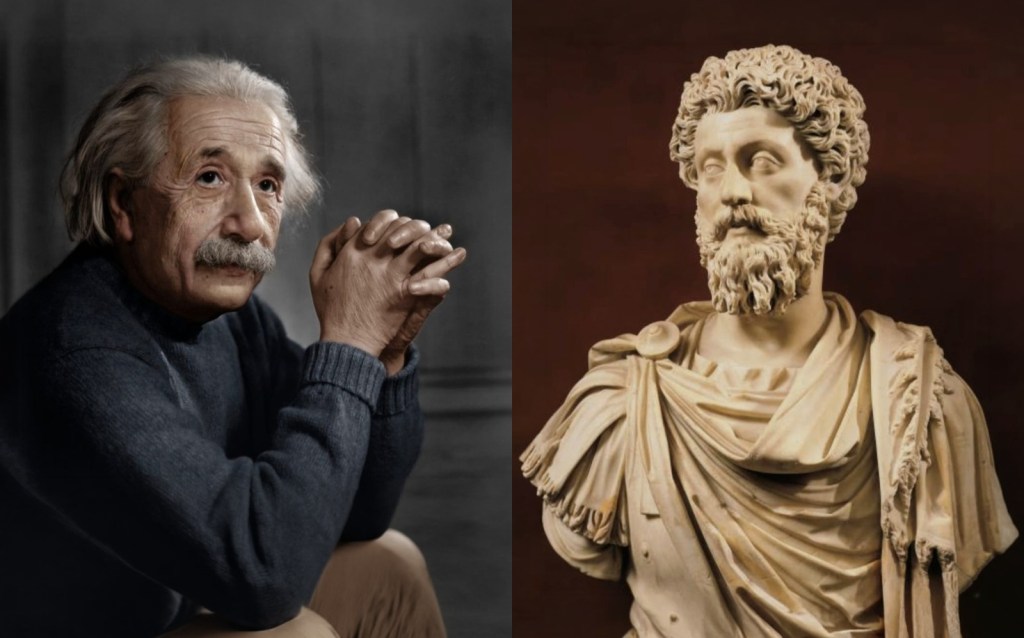
Mediation, the only book authored by Marcus Aurelius, is a gem in Stoicism, the most prevailing school of philosophy. Although written around 1800 years back, it is still the most treasured book for any student of philosophy. What awed me while reading this book was that how he got time for such deep thinking about human nature and reflections of human behavior as well as for the observations and understanding of nature — the nature of the universe– even when he had to shoulder the responsibility of running the largest kingdom, including waging many a battle in the distant lands! Albert Einstein is possibly the genius of all times and was ahead of his time as the scientific fraternity had to do a lot of catch up to understand his theories and discoveries, with his contributions having visible impacts on even our daily life — Google map and GPS working on the principles of Einstein’s theories of relativity being a few such examples.
Both Marcus Aurelius and Albert Einstein said something about imagination. “Wipe out imagination,” Marcus Aurelius wrote in Meditations while Albert Einstein’s take on imagination: “Imagination is more important than knowledge.” Two best brains telling diametrically opposite things about the same thing! How could that be possible? There is no question of who was right or wrong as both were governed by reason which could not go wrong. So the only task left with any curious student of their teachings is to try to understand the context in which imagination was explained and the meanings attributed to it by them in each context. In other words, though their quotes apparently sound diametrically opposite, the meanings they attributed to imagination were impeccably correct. Let’s look a bit deep into their thoughts about imagination.
The quote by Marcus Aurelius on imagination sounds antithetical to common sense! He was a deep thinker, to say the least. I read Mediations three times and would read again if time permitted me. This is the best book I ever read! It will be a read-pause-think-and-read-again sequence for anyone as he/she goes through this book — one has to spend a lot of time to understand his thoughts, and it took more than a month for me to complete his 201-page thoughts. In the Book IX — Mediations is sectioned as Books from Book I to Book XII — Marcus Aurelius talks about the importance of living the present. He says, “It is enough for man to have the current opinion based on understanding, the present conduct aimed at social good and the present disposition of contentment about everything that happens.” Such a state of living — anchored on the ground of facts, along with having common good as the guiding force and being happy with as things unfold in our life — can be achieved only if man realizes that the past is history, the future is unknown so uncertain and the present is the only real that man can dwell. Keeping the present undaunted by the past and incurious about future, however, is a challenge that none can escape from.
Human nature is such that we take unusually longer time to bury the hatchet, besides, having the insatiable yearning for more even when there is plenty on the table, thereby making living the present a difficult task. So Marcus Aurelias says that the best way to live the present is by not adding anything from the past to your present as well as by not having any apprehensions about the future — wipe out your imagination that is housed with the past and future. The choice of the term “wipe out” was not incidental but intellectual as it stood for complete elimination. The best way to live the life is living the present, and the most fruitful way to live the present is by making the present completely devoid of both pleasant and unpleasant incidents of the past and of the apprehensions about the future.
Einstein’s words of imagination being more important than knowledge has much more in depth than what it apparently sounds. Though it sounds simple and easily comprehensible, Einstein would have thought and deliberated himself a lot before giving such a quote because it broke the conventional precept: knowledge is supreme. Knowledge cannot be discounted in ordinary circumstances. Our capabilities, skill, education, experience, intelligence and wisdom run on knowledge. If we take the most important faculty, that is, wisdom, it, too, is knowledge. The Stoic philosopher, Arius Didymus (BC 70 to AD 1010), explained wisdom this way, “Wisdom is the knowledge of what things must be done and what must not be done and what is neither or appropriate acts.” In other words, wisdom is the knowledge in you which tells you to choose the best option out of the options put forward by your intelligence. So knowledge is paramount, and it is not that Einstein did not know about the pinnacular value of knowledge to keep it below imagination, still, he kept imagination above knowledge. Why?
Imagination can be a harbinger of new knowledge, so does knowledge have the ability to power imagination. One can lead to the other and vice versa, showing their competing importance if that is the way to look at them. From a possessional point of view, knowledge, though can be open-ended, many a time is limited as it stands where. But imagination not only is open-ended but also does have no limits; imagination can be stretched as much as the observable universe, possibly beyond. Human abilities can be scaled to unimaginable capabilities — ability to run and scaling it up to the capability of running 100 meters in 9.58 seconds as done by Usain Bolt — and the limit of this scaling up is relative but has upper threshold with no ceiling. Imagination does exactly fit into the limitless potentials of human faculties. This unlimitedness catapults imagination one pedestal above knowledge. And it could be the rational behind the invaluable words about imagination from Einstein.
Two great minds which never crossed their paths had explicitly opposite views on imagination, and both views stood correct in their own contextual perspectives. It is evident that there is no sequential relevance between these perspectives, but they give a peep into two historic personalities on how they conjured up imagination in their own merits.
 Nowhere Perspectives