One of the discomforts that I am forced to go through is seeing people taking umbrage at the bold statement that one man’s right is another man’s wrong and that wrong and right are subjective. Is this true? Good and bad also get buffeted by similar linking and callous hits through the open justification that good or bad is largely person-centric, hence, is subjective tied to a person’s perspective. Though this thinking, for argument sake, may seem to hold some water, it is still a misfit with what good or bad stands for. Furthermore, man often gets confused with correctness for right and good, and, in the same way, incorrectness for wrong and bad though being correct and incorrect are the ways to be right and wrong, respectively.
The standards and norms of rightness are not set by the hands of man but nature, with man only having the choice of being either in harmony or disharmony with them — each having its own consequences. Any argument alluding or explicit that man sets the foundational rules governing right or wrong is an antithesis, for the principles underpinning the rights are universal in nature. They, like water boiling at 100 degree centigrade at normal atmospheric conditions, whether it is in India or the U.S.A., are non-negotiable, to say the least. Nature sets the rights flawlessly to differentiate them from the wrongs and goes to any lengths to uphold them. To substantiate this point, nature has kept innumerable illustrations for anyone who cares to notice them.
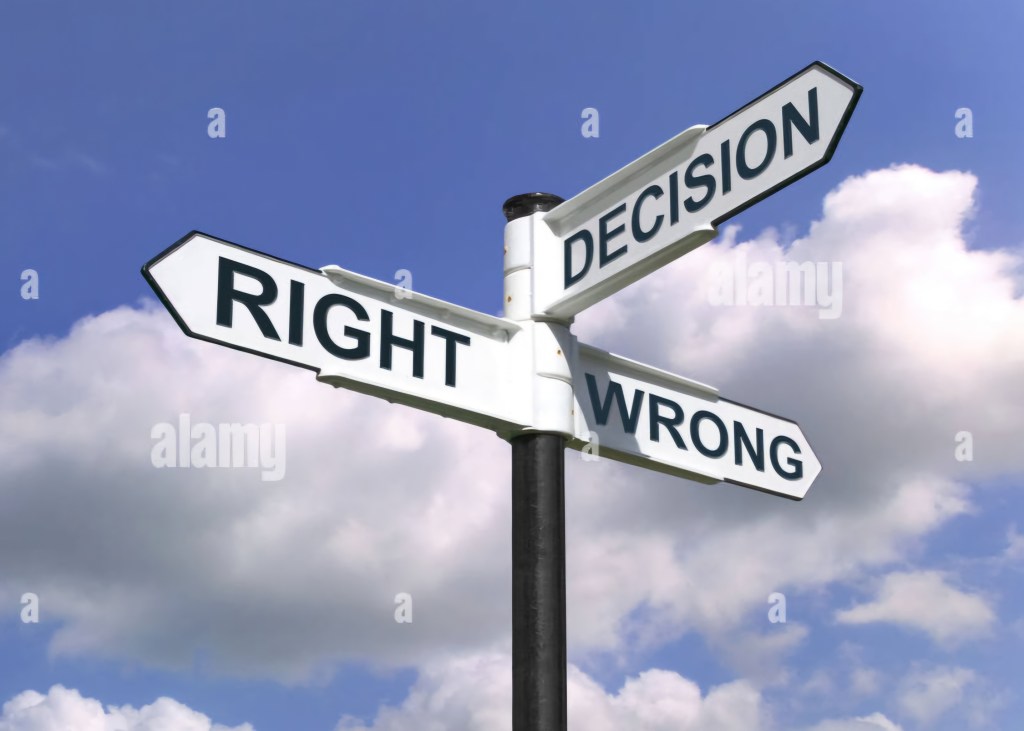
What is right or wrong? In other words, what can be called right or wrong? Anything that is in harmony with natural laws is right and that in disharmony wrong. Nature does not err, nor does it portray wrong as right and vice versa. Like man cannot physiologically — hence, mentally — mimic happiness, nature does not pretend because both its organic and inorganic existences are governed by the stable laws. Nature is nakedly honest in applying these laws impartially, irrespective of who faces the consequences of those laws. In other words, nature is always true to its indisputable laws. Gravity causes a falling object to fall at a faster and faster velocity that accelerates at the rate of 9.8 m/s2. So the impact and damage of a fall from, say, the 9th storey of a building will be much higher than that of a fall from the 2nd storey. Nature is honest in applying this law across any man or object falling, and it says so openly to anyone who bothers to study its laws. Louis-Sébastien Lenormand invented the parachute after understanding this gravitational rightness and designed the skydiving gadget, accordingly. And any wrong — disregarding this gravitational rightness – in the designing and operation of a parachute can result in the wrong of a fatal fall. Impartiality and indisputability are the characteristics of natural laws, making them universal principles. So nature says that anything that is in line with its universally applicable principles is right. Conversely, anything that is diametrically opposite to this principle-centric approach is wrong. Honesty is the principle of telling truth, and truth is something that is indisputable. Consequently, there is nothing called half-truths because they can be disputed. Ultimately, it is either true or false with no grey area in between. So there shall not be any confusion to say that honesty is principle-based, not person-centric, hence, a virtue of rightness and that dishonesty is wrongness — somebody’s right is everybody’s right, and someone’s wrong everyone’s.
How does right or wrong get portrayed as subjective instead of objective? Our mental space is shared between cognitive elements, which constitute consciousness, and non-cognitive elements like desires, pleasure and pain. In order to entertain our non-cognitive elements, we get inclined to subdue our cognitive skills, opening the green channel to justify our actions as right even when they are wrong. In this process, cognitive elements like logical reasoning attributed to our thoughts might get muted. Hence, objectivity is knowingly or unknowingly made to disappear, resulting in subjectivity taking hold.
Is good analogous to right and bad to wrong? Goodness is the after effect of being right. In other words, goodness is the feeling generated by doing the right things. For example, the feeling one gets by being honest is indisputably a feeling of goodness. It is not natural for a wrong to create a feeling of good though it may be possible that the contrary can happen sometimes. There are people who feel good when they do wrong things — something that is not in harmony with natural laws. A dishonest man may feel good in having booties from the dishonest deeds. These examples of (dis)honesty may make one think that good or bad is person-centric. However, goodness can not, as nature shows us — be associated with things that are wrong. So, how do we reconcile? While an honest man never defines himself as bad for being honest, a dishonest man may or may not define himself as good for being honest. This ‘may not’ affirms the fact that a wrong act can not inherently produce good feelings. The fact that acts of dishonesty can not invariably produce goodness emphasizes that wrong ultimately produces badness. That being so, the consequence of being on the side of rightness is goodness while it is badness with respect to wrongness.
When we talk about correctness, it always points to a way for being good or doing what is right. In other words, correctness is the unwritten procedural way — however, short or long that may be — to be right, so is incorrectness to wrong. The correct ways to be honest include both avowing to be on the side of right as well as pledging to be away from wrong. Vows on both these fronts are necessary because we have both conscious and unconscious motives. Our conscious motives can be tamed by the principles of rightness. However, our unconscious motives can surface suddenly, overwhelming — and sometimes even being successful in overrunning — the principles of rightness. So it is imperative that in order to be in the path of rightness, we also take vows to disallow the unconscious motives to have any say. The correctness of being honest involves not only sticking to the principles of truth but also guarding oneself against the pleasures that dishonesty promises to provide.
You can choose to be on the side of either right or wrong, but to feel good within you, you have no right to be wrong but right.
 Nowhere Perspectives