We often come across people who gloat over the mountain of knowledge they are carrying. There are others who compare themselves as better folks than everyone around. Some others go to the extent of feeling that they are polymaths who could answer queries of anything and everything. The breeds that think that having higher physical strength or wielding powers make them big are not less in our society. These and similar megalomaniac expressions are borne out of the poor understanding of oneself vis-a-vis the limitless, fathomless knowledge and phenomena that the universe has kept out in the open and beyond. Such vainglory thoughts show the lack of discern to understand how insignificant man is in the universal canvas and how smaller and smaller he is becoming in this ever-expanding universe. The wise souls, who lived hundreds of years ago when the understanding of the universe was limited to some elements of earth and the solar system, knew the littleness of man’s knowledge. The 2400-year-old quote, “I know that I know nothing,” by Socrates captures the essence that the knowledge man claims to have acquired is not even a little but little in the backdrop of the endless horizons of knowledge kept open to explore by the universe.
Space and time in various logical permutations and combinations are used by the universe to reveal its thoughts, wishes and demands. So if we evaluate man using these two universal dimensions, we will get an idea where man stands in his claim of being big. The diameter of the earth is 12,756 km, and though this is a good spatial coverage, it is too small in our solar system, which has a diameter of 287.46 billion km. Such a vast solar system, however, is only a dot among the many other solar systems in our Milky Way galaxy. The Milky Way boasts a diameter of 105,700 light-years — a light-year is 9460800000000 km. So the diameter of Milky Way is 105700×9460800000000 km. Unsurprisingly — from the perspective of the universe– this gigantic Milky Way is another small dot in the numerous galaxies in our universe whose observable reach from the earth is 93 billion light-years. And the universe is still expanding at the speed of light, i.e., 300,000 km/second. Imagine what vast knowledge and phenomena the universe has kept in this immenseness of planets, solar systems, galaxies and beyond!
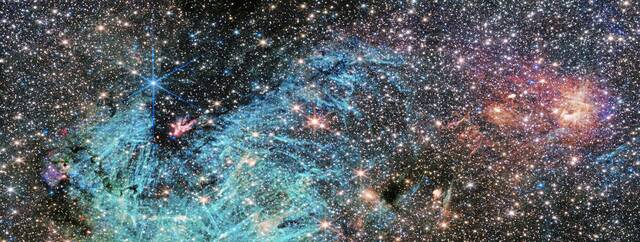
So, how big is man in this infinite universe? Man is not even a dot in the universe — too small to be considered as something. What level of knowledge has man acquired as compared to the knowledge out there in the observable universe and beyond? Little. I do not know every place and aspect of my village: Chavara Thekkumbhagom, which is only 8 sq. km, where I was born. I think this is same for almost all the humans born on this planet. As man stands as an insignificant dot and that the knowledge he has is little, can anyone claim to be a polymath or to carry a mountain of knowledge?
Our universe is 13.80 billion years old; the sun is 5 billion years old while earth 4.60 billion years. The first living nucleus is estimated to have sprouted 3 80 billion years ago, and the first Homo sapien: Lucy, whose fossil remains were exhumed in 1974 in Ethiopia, is estimated to have lived 3.20 million years back. Modern Homo sapiens are believed to have started roaming on the earth 200,000 years back. Vastness of times had been elapsed before us, and even more times would unfailingly succeed us, with each segment holding unimaginable information and knowledge. A life of 70 or 80 years is only an incipient flash to understand anything significant from the knowledge layered in such an extensive time dimension of the universe.
There are billions of stars that are billions of light years away, which have started their journeys to earth before we were born but would not meet us because our time is too short on this planet. And most stars which light the night skies are already dead to become black holes, but we see them because the lights emitted by them before their death are still travelling to earth. Interestingly, we do not know which of these stars are dead or alive — so even making a wish on a star can be a wishful thinking. In such oblivious vastness of time, man’s short lifespan gives him not enough time to acquire anything that can be called big.
A picture of the “Pillars of Creation” sent by James Webb Space Telescope:
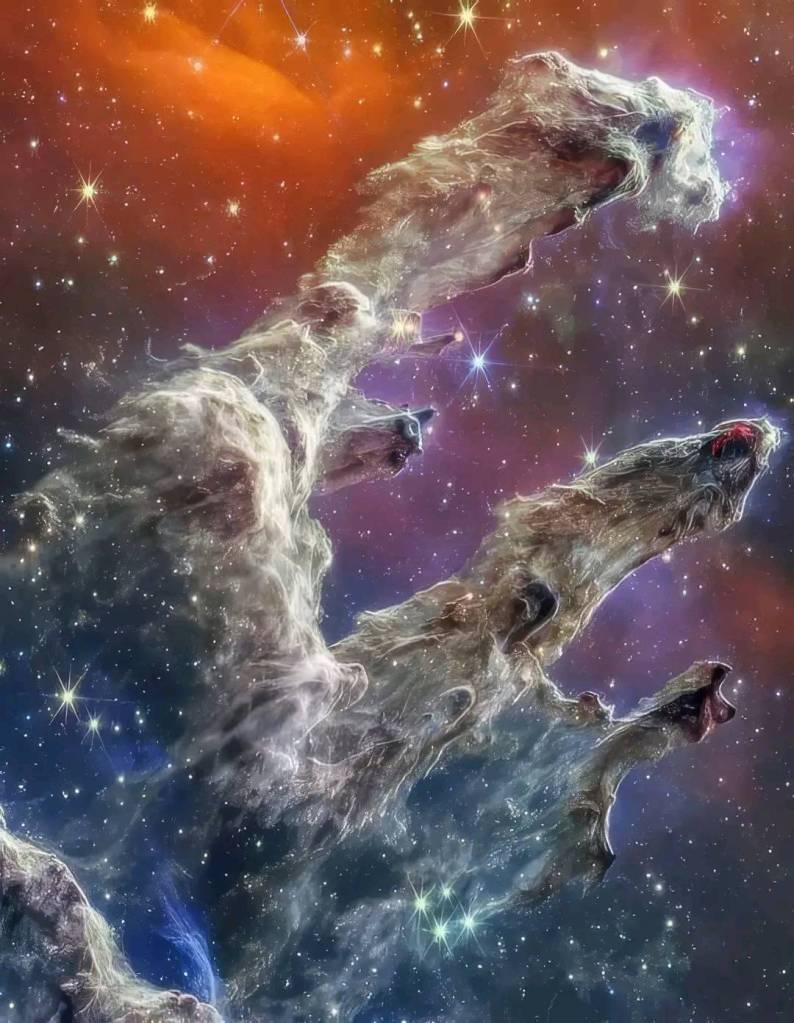
The universe is willing to reveal everything about it to a man who is willing to explore it. The first interstellar probe: James Webb Space Telescope sending valuable information on the ‘Pillars of Creation,’ star births, nebulas, black holes, interstellar dust gains and other galactic phenomena is the illustration of the universe’s willingness to let man know its secrets. At the same time, man does not have the faculties — at least, the universe thinks so — to acquire and hold all that the universe is willing to divulge. In the last 2500 years of known human history, only one man: Buddha is known to have attained enlightenment, or Nirvana. However, Buddha’s enlightenment was broadly spiritual revelation that also had meaningful pointers for physical and mental wellbeing. But Buddha never talked about the factors like the circumference of earth, the speed of light or how stars are formed because probably, such things were not revealed to him by the universe after realizing that even an enlightened brain was too small to hold the vastness of knowledge in its repertoire.
I remember Time magazine featuring the cricket maestro, Sachin Tendulkar, on its cover page a few years back. In the article, the author listed out some unique qualities of Sachin Tendulkar as a cricketer, and one of them had a connection to his physical atribute. That quality was good peripheral awareness, enabling him to have a quick assessment of the fielders positioned and adjust his game, accordingly. This spatial awareness was accentuated to the best level due to his feature of no-tall physique. It is a scientific fact that when you are shorter, you have a lower centre of gravity, giving more room for manoeuvrability. The point I am trying to put across is that man should look around for a better understanding of people and things and that he can do it effectively if he does it from a mental frame of humility. The universe has set spatial dimension in such a way that man needs to take one step back without mitigating his self-respect in order to better understand the universe and its creations, including his fellow beings.
It is unavoidable, though not inevitable, that people get carried away by their success, making them overly proud about their achievements. That catapults them to think that they are big and highly knowledgeable. For all of them, the universe has this simple message: it is plain at the peak!
 Nowhere Perspectives